If you need a birth certificate, diploma, marriage record, or corporate document recognized by an authority in Mexico, you will almost certainly be told that the paper needs an apostille. This single word causes more confusion than almost any other term in international document processing, yet the concept is fairly simple once you understand it. This guide walks through exactly how to apostille a document for Mexico, using the same standards and offices that Mexican consulates and government departments rely on when they confirm whether a foreign document is valid for use inside the country.
Whether you are relocating for work, getting married in Mexico, enrolling in a Mexican university, opening a business, or handling a legal matter such as an inheritance or a power of attorney, the underlying process is the same. You need a document that a Mexican registry office, court, school, or notary will accept without asking for further proof that it is genuine. An apostille is proof.
What an Apostille Actually Is
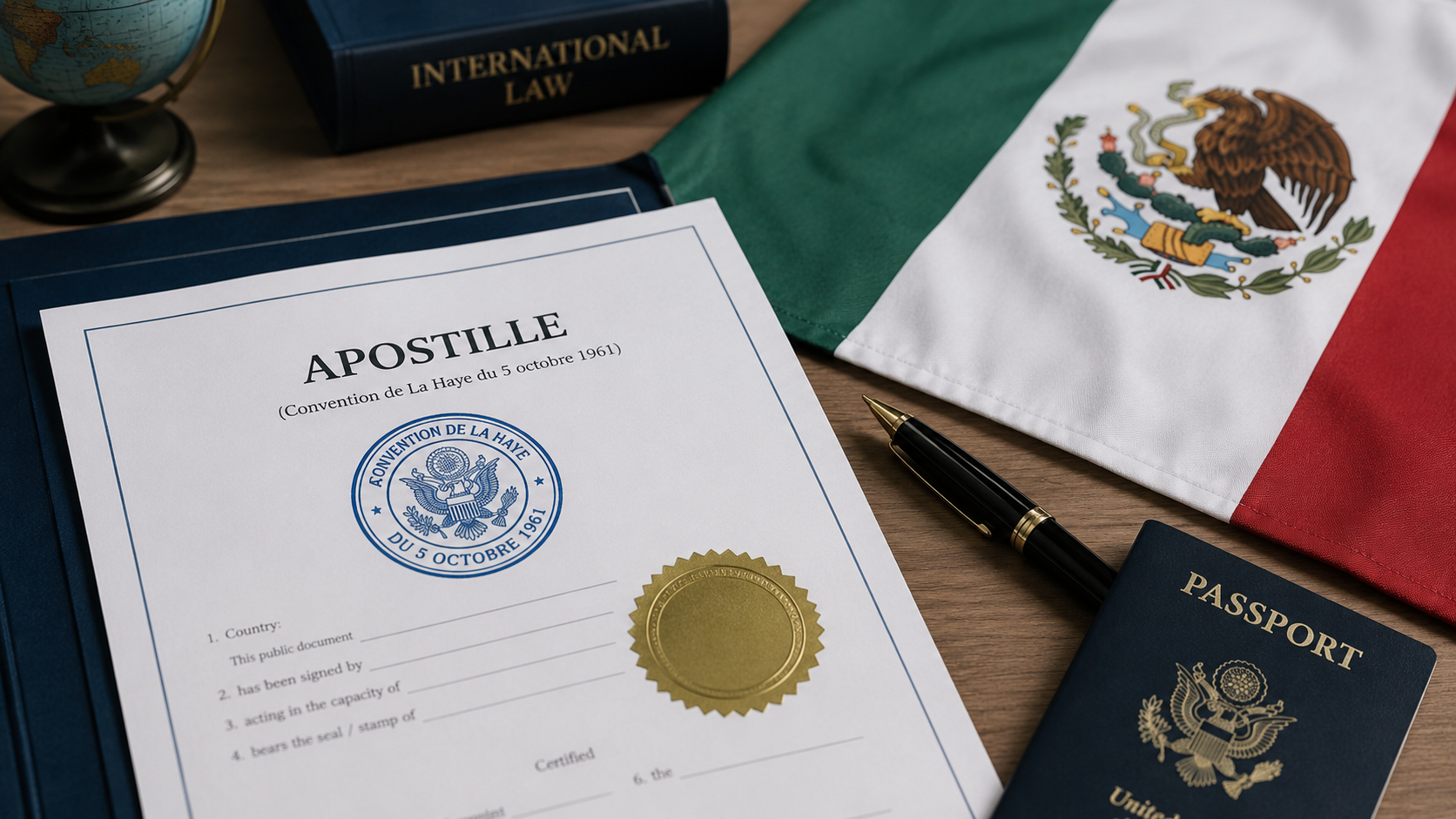
An apostille is a certificate issued by a designated government authority that confirms a public document is authentic. It confirms the signature on the document, the capacity in which the signer acted, and, where relevant, the seal or stamp attached to it. It does not certify that the content of the document is true, only that the document itself was issued by a legitimate authority and signed by someone with the power to do so.
The apostille system exists because of the Hague Convention of 5 October 1961, an international treaty that removed the older, slower requirement of full consular legalisation between member countries. Before this treaty, a document travelling from one country to another often needed to be certified by several different offices, ending with a stamp from the destination country’s embassy or consulate. The apostille replaced that chain with a single certificate recognized by every member state.
People oftenMexico joined the convention and it entered into force there on 14 August 1995. This means that any public document issued in another member country, once apostilled in that country, must be accepted in Mexico without any additional legalisation from a Mexican consulate. This is the exact reason people search for how to apostille a document for Mexico rather than asking how to have a document legalised, since legalisation is a separate and older process reserved for countries that never joined the treaty. Anyone preparing to apostille a document for Mexico should start with this distinction, since it determines every step that follows.
Why Mexico Requires an Apostille
Mexican institutions, from the Registro Civil to universities and notaries, need a fast and reliable way to know that a foreign birth certificate, degree, or affidavit is not fraudulent, which is the whole reason someone needs to apostille a document for Mexico in the first place. Rather than verifying every signature themselves, they rely on the apostille certificate issued in the document’s country of origin. Once that certificate is attached, the Mexican authority treats the underlying document as authentic and moves forward with whatever registration, enrollment, or legal process is being requested.
This is why almost every person dealing with Mexican bureaucracy, whether a foreign national moving to Mexico or a Mexican citizen with documents issued abroad, eventually needs to apostille a document for Mexico before that document will be accepted.
Which Documents Typically Need an Apostille for Mexico
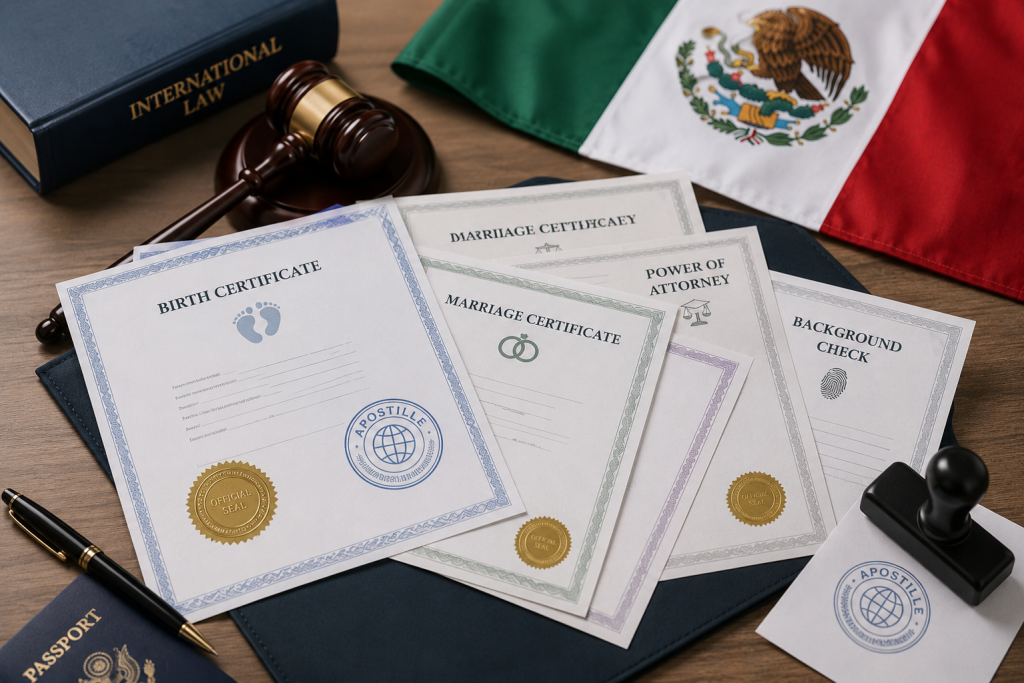
The list of documents that commonly require an apostille for use in Mexico includes the following.
Birth certificates, needed for residency applications, school enrollment, and civil registry matters.
Marriage certificates, required when registering a marriage that took place abroad or when applying for a Mexican marriage license as a foreign national.
Divorce decrees, often requested before a new marriage can be registered in Mexico.
Death certificates, used in inheritance and probate matters.
Academic diplomas and transcripts, needed for university enrollment, professional licensing, and job applications that require credential recognition.
Police clearance or background check certificates are frequently requested for residency permits and certain types of employment.
Powers of attorney, used when someone abroad needs to authorize a representative to act on their behalf in Mexico for property, business, or legal matters.
Corporate documents such as articles of incorporation, certificates of good standing, and board resolutions, needed when a foreign company registers a subsidiary or signs contracts in Mexico.
Single status affidavits, sometimes required alongside a divorce decree or death certificate when applying for a marriage license.
Adoption papers and other family court records are needed for cross-border adoption cases.
Each of these falls into one of two broad categories. A public document, one issued directly by a government office, court, or vital records agency, can usually go straight to the apostille authority. A private document, such as a document prepared by a company, an individual, or a professional, typically needs to be notarized first so that it becomes eligible for the apostille process.
Step One, Confirm the Document Is Eligible
Before anything else, confirm that the paper you are holding is the kind of document that can be apostilled. Only public documents and properly notarized private documents qualify. A photocopy of a document, a document that has already expired, or an informal letter will usually be rejected by the apostille office.
If the document is a vital record such as a birth or marriage certificate, request a certified copy directly from the vital records office or registrar that issued it. Many apostille offices will not accept a certificate that was printed at home or that shows visible signs of alteration. If the document is academic, contact the registrar of the school for an original, sealed transcript or diploma, since photocopies are rarely accepted.
Step Two, Notarize Private Documents
If your document is not a government issued public record, it generally needs notarization before it can move forward. A licensed notary public reviews the signature, confirms the identity of the signer, and applies a notarial seal. This step converts a private document into something the apostille authority can certify, since the apostille itself is only verifying the notary’s signature and seal, not the underlying content.
Common examples include powers of attorney, sworn statements, business letters, and translations prepared by a private translator. Skipping notarization when it is required is one of the most frequent reasons a document is rejected at the apostille stage.
Step Three, Identify the Correct Apostille Authority
This is the step where most confusion happens, because the correct office depends entirely on where the document was issued, not on the fact that it is destined for Mexico.
In the United States, each state has its own apostille authority, almost always the Secretary of State’s office in the state where the document was issued. A birth certificate from Texas must be apostilled by the Texas Secretary of State, while one from California goes through the California Secretary of State. Federal documents, such as an FBI background check, are apostilled by the US Department of State in Washington.
In the United Kingdom, all public documents are apostilled by the Foreign, Commonwealth and Development Office. Private documents such as academic certificates and translations must first be authenticated by a solicitor or notary public before the Foreign, Commonwealth and Development Office will apply the apostille.
In Canada, the process runs through Global Affairs Canada, since Canada joined the Hague Convention more recently and now issues its own apostilles rather than relying on Mexican consular legalisation. Knowing which of these offices applies to your paperwork is the real starting point for anyone trying to apostille a document for Mexico.
If you already hold a Mexican public document that needs an apostille for use in another member country, the process runs in the opposite direction, and the offices involved are different from the ones used to apostille a document for Mexico from abroad. Federal Mexican documents are apostilled through the Secretaria de Gobernacion, specifically the office known as the Coordinacion General Politica con Poderes de la Union in Mexico City. Documents issued by Mexico City authorities go through the Direccion General Juridica y de Estudios Legislativos, and documents issued by any other state go through that state’s Secretaria or Direccion General de Gobierno.
Knowing this distinction matters enormously. People often assume they should contact a Mexican consulate to apostille a document for Mexico, but consulates in member countries generally do not issue apostilles at all. Their role today is limited mainly to non Hague countries, where full legalisation is still required.
Step Four, Submit the Document and Pay the Fee
Once you know the correct authority, the submission process usually involves mailing or delivering the original document along with a completed request form and the applicable fee. Processing times vary widely. Some state offices in the United States turn documents around within a few business days, while others, especially when processed by mail, can take several weeks. The Foreign, Commonwealth and Development Office in the United Kingdom typically advises a similar range, and expedited services are often available for an additional cost.
Fees vary by jurisdiction and document type. If your situation is time sensitive, such as a visa interview or a property closing in Mexico, ask the issuing authority whether expedited or same day service is offered.
Step Five, Arrange a Certified Spanish Translation
An apostille confirms that a document is authentic, but it does not translate the content. Mexican institutions almost always require documents to be presented in Spanish, so once your document has been apostilled you will typically need a certified translation prepared by a qualified translator.
It is important to translate the document only after the apostille has been affixed, since the apostille certificate itself, along with any attached seals, also needs to be reflected in the translation. Some Mexican authorities require the translator to be a “perito traductor” registered with a local court, particularly for use in legal proceedings, so it is worth confirming this requirement with the receiving institution in Mexico before finalizing the translation.
Understanding the Difference Between Apostille and Legalisation
People frequently use these two terms interchangeably, but they describe different processes for different sets of countries. An apostille is a single step certificate used between countries that are both members of the 1961 Hague Convention. Legalisation, by contrast, is a longer chain of authentications used when at least one of the two countries involved has not joined the convention.
Since Mexico has been a member since 1995 and most of its trading partners, including the United States, Canada, the United Kingdom, and the European Union countries, are also members, the overwhelming majority of documents destined for Mexico only need an apostille rather than full legalisation. This is good news for anyone who needs to apostille a document for Mexico, since it means one certificate is usually enough, without a lengthy chain of additional authentications. Confirming your country of origin’s membership status before you begin is a useful first check, since a small number of countries around the world still require the older legalisation route.
Common Mistakes That Delay the Process
Even straightforward requests can be delayed by a handful of avoidable errors.
Sending a photocopy instead of an original certified document is one of the most common reasons an apostille request is returned. Apostille authorities generally require an original or a certified copy, not a scan or a plain reproduction.
Forgetting notarization on a private document is another frequent issue, since the apostille office cannot certify a signature that has not first been verified by a notary.
Translating a document before it has been apostilled often means the translation has to be redone, since the translated version needs to include the apostille certificate itself.
Using an outdated or expired certificate, particularly with police clearance letters, can also cause rejection, since many Mexican institutions only accept documents issued within a set number of months.
Assuming that a Mexican consulate can issue the apostille is another common misunderstanding. In countries that are Hague Convention members, the apostille comes from a domestic government office, not from a Mexican consulate. Most of the delays in this list come down to the same root cause, rushing to apostille a document for Mexico without confirming the right sequence first.

How Long the Full Process Usually Takes
Timelines depend on the type of document, the issuing jurisdiction, and whether translation is also required. As a general guide, obtaining a certified copy of a vital record can take anywhere from same day service at a local registrar’s office to several weeks if requested by mail from another state or country. The apostille itself often takes between a few days and three weeks depending on the office and whether expedited service is requested. A certified Spanish translation typically adds a few more business days.
Because these steps happen in sequence, most people should plan for the entire process, from ordering the original document to receiving a translated, apostilled paper ready for use in Mexico, to take anywhere from two to six weeks. Anyone who needs to apostille a document for Mexico on a deadline should factor in this full timeline rather than just the apostille step alone. Building in extra time is especially wise if your document is needed for a fixed date such as a wedding, a court hearing, or a visa appointment.
Special Considerations for Common Situations
Marriage in Mexico. Foreign nationals marrying in Mexico are usually asked for an apostilled birth certificate and, if previously married, an apostilled divorce decree or death certificate. Some Mexican states also require a certified translation and, in certain cases, a single status affidavit.
Residency Applications. Mexican immigration authorities frequently request an apostilled police clearance certificate and, depending on the visa category, apostilled proof of income, marriage, or family relationship documents.
University Enrollment. Mexican universities generally require an apostilled diploma and transcript, along with a Spanish translation, before a foreign academic credential will be recognized for admission or professional licensing purposes.
Business and Property Transactions. Foreign companies establishing a presence in Mexico, or individuals buying property, often need apostilled corporate documents or a properly apostilled and notarized power of attorney so that a representative in Mexico can sign on their behalf. In each of these situations, the underlying task is the same, you need to apostille a document for Mexico before the receiving institution will act on it.
Working With a Professional Apostille Service
Given how many moving pieces are involved, from identifying the correct issuing authority to arranging notarization and certified translation, many people choose to work with a dedicated apostille service rather than manage every step themselves. A professional service can confirm exactly which authority is responsible for your specific document, track it through processing, arrange for a qualified translator familiar with Mexican requirements, and flag any issue, such as an expired certificate, before it causes a delay.
This is particularly valuable for anyone trying to apostille a document for Mexico from overseas, since mailing an original document internationally and coordinating with a foreign government office can be difficult to manage without local knowledge of processing times, fee schedules, and submission requirements.
Mexico Apostille Pricing and Turnaround
| Service | Our fee | Turnaround |
|---|---|---|
| State apostille | From $195; additional documents $65 each, plus the state fee | About 10 business days, depending on state delays |
| FBI apostille | $195 | 5+ weeks (regular U.S. Department of State processing) |
| Expedited FBI apostille | $390 | 10 business days |
Notary and translation fees are separate. See our Mexico apostille service, full apostille pricing, or request a quote.
Frequently Asked Questions
Can a Mexican consulate apostille a document for Mexico?
In most cases no. If your document originates in a country that belongs to the Hague Convention, the apostille must come from a domestic authority in that country, such as a state office or a national foreign affairs department. Mexican consulates generally handle legalisation only for documents coming from countries outside the convention.
How much does it cost to apostille a document for Mexico?
Costs vary by country and document type, and they typically range from a modest government processing fee to a higher amount if expedited service is requested. Working with a professional service adds a service fee on top of the government cost, but it often saves time and reduces the risk of a rejected submission.
Do I still need an apostille if a document was already notarized?
Yes. Notarization and apostille serve different purposes. A notary confirms a signature at the time it was made, while an apostille confirms that the notary themselves was authorized to perform that act. Both steps are usually required for private documents.
Can I complete this process myself without a lawyer?
In many cases yes, since the process is administrative rather than legal. However, identifying the correct authority, avoiding common mistakes, and coordinating translation can be time consuming, which is why many people choose professional help, especially for time sensitive matters.
What happens if my document is rejected?
If a Mexican institution rejects a document, it is usually because of a missing notarization, an outdated certificate, or a translation completed before the apostille was affixed. The good news is that most rejections can be corrected by returning to the appropriate step and resubmitting the corrected document.
Final Checklist Before You Begin
Confirm the document is an original or certified public record, not a photocopy.
Notarize any private document before submitting it for an apostille.
Identify the correct issuing authority based on where the document originated, not on its destination.
Submit the request with the correct fee and allow adequate processing time.
Arrange a certified Spanish translation only after the apostille has been affixed.
Double check any specific requirements from the Mexican institution that will receive the document, since some courts, universities, and civil registries have their own additional rules. Working through this checklist in order is the most reliable way to apostille a document for Mexico without a rejected submission.
Conclusion
Learning how to apostille a document for Mexico comes down to understanding a few core ideas. Mexico has recognized the Hague Apostille Convention since 1995, so nearly every public document issued in a member country only needs a single certificate rather than a lengthy legalization chain. The key is identifying the correct authority in the country where the document was issued, making sure any private document is properly notarized first, and arranging a certified Spanish translation once the apostille has been attached.
Taking the time to prepare each document correctly, in the right order, saves weeks of delay and avoids the frustration of a rejected submission. Whether you are handling a single birth certificate or a full set of corporate documents for a new business, following these steps carefully will help ensure your paperwork is accepted the first time it is presented in Mexico. Once you know how to apostille a document for Mexico, the process becomes far less intimidating each time you need to repeat it.
Related guides: Apostille Countries: The 2026 Essential Complete List