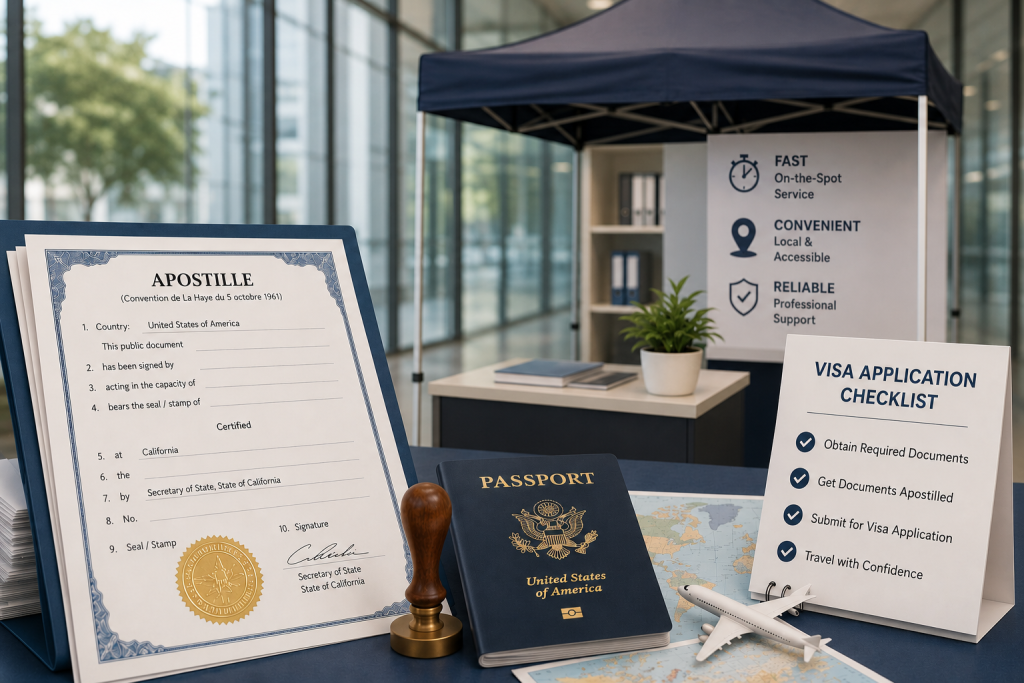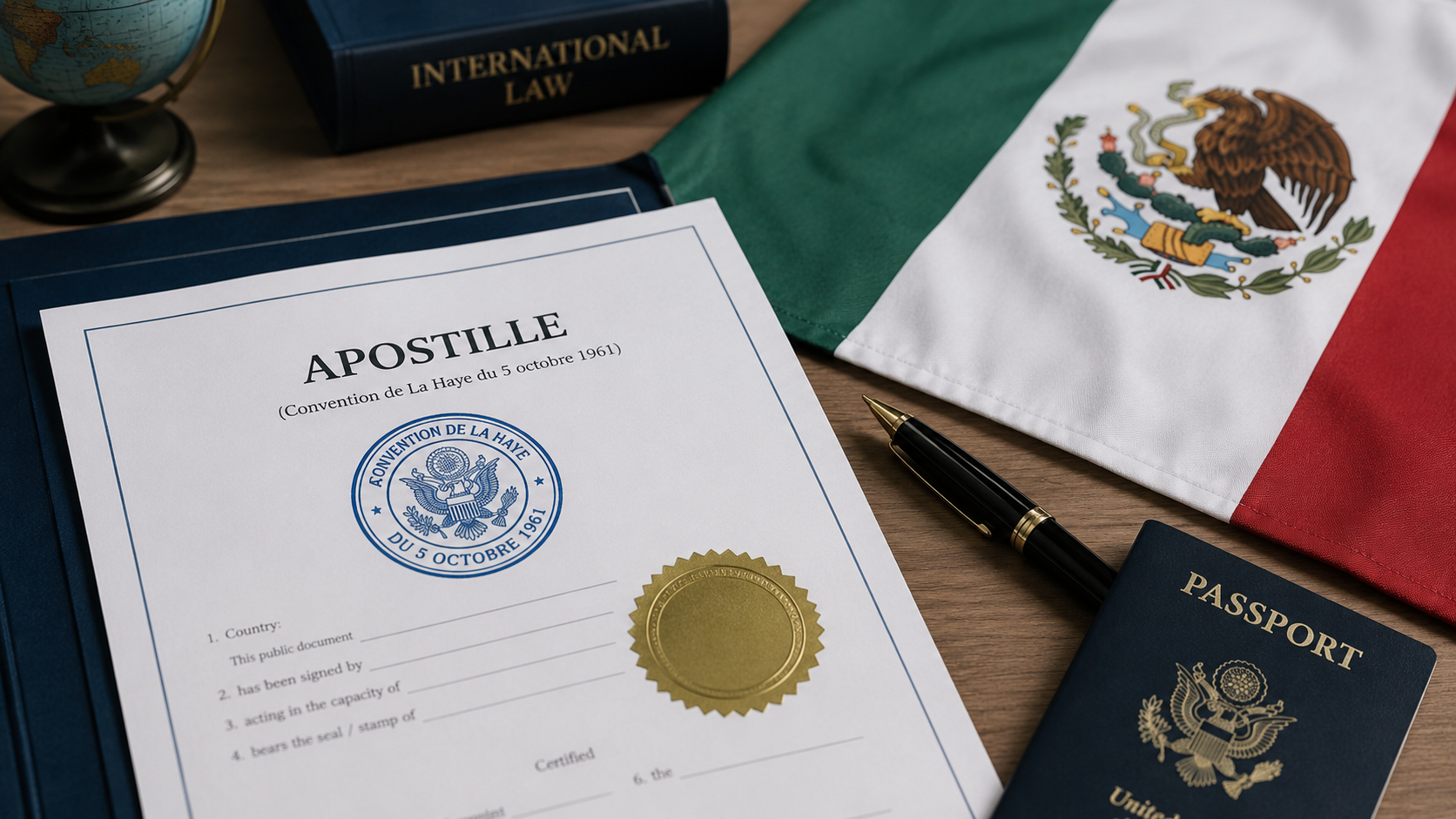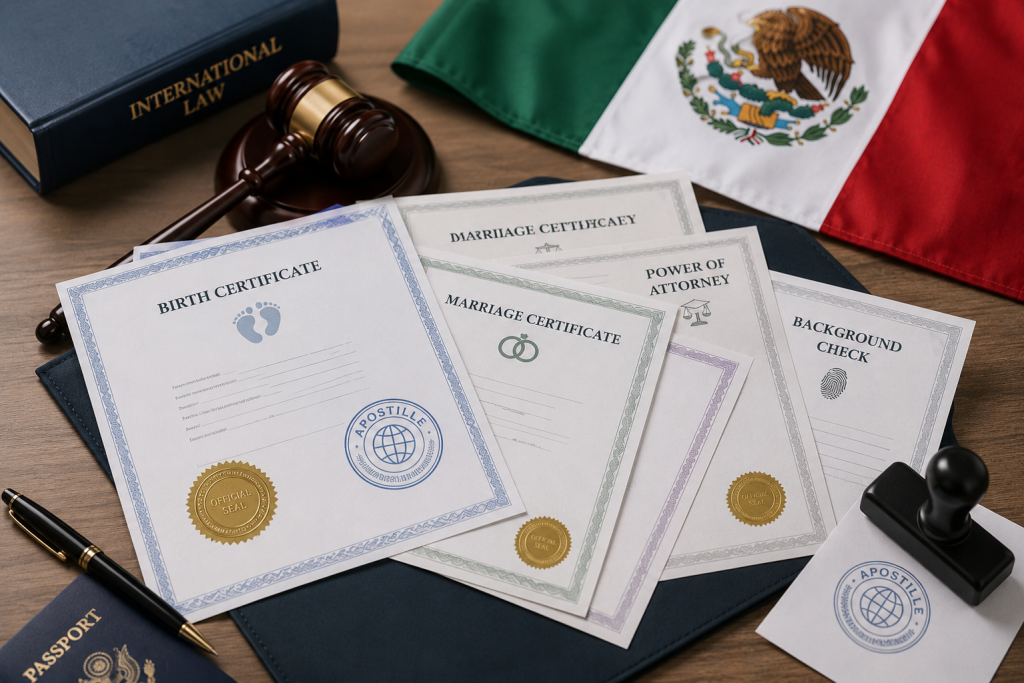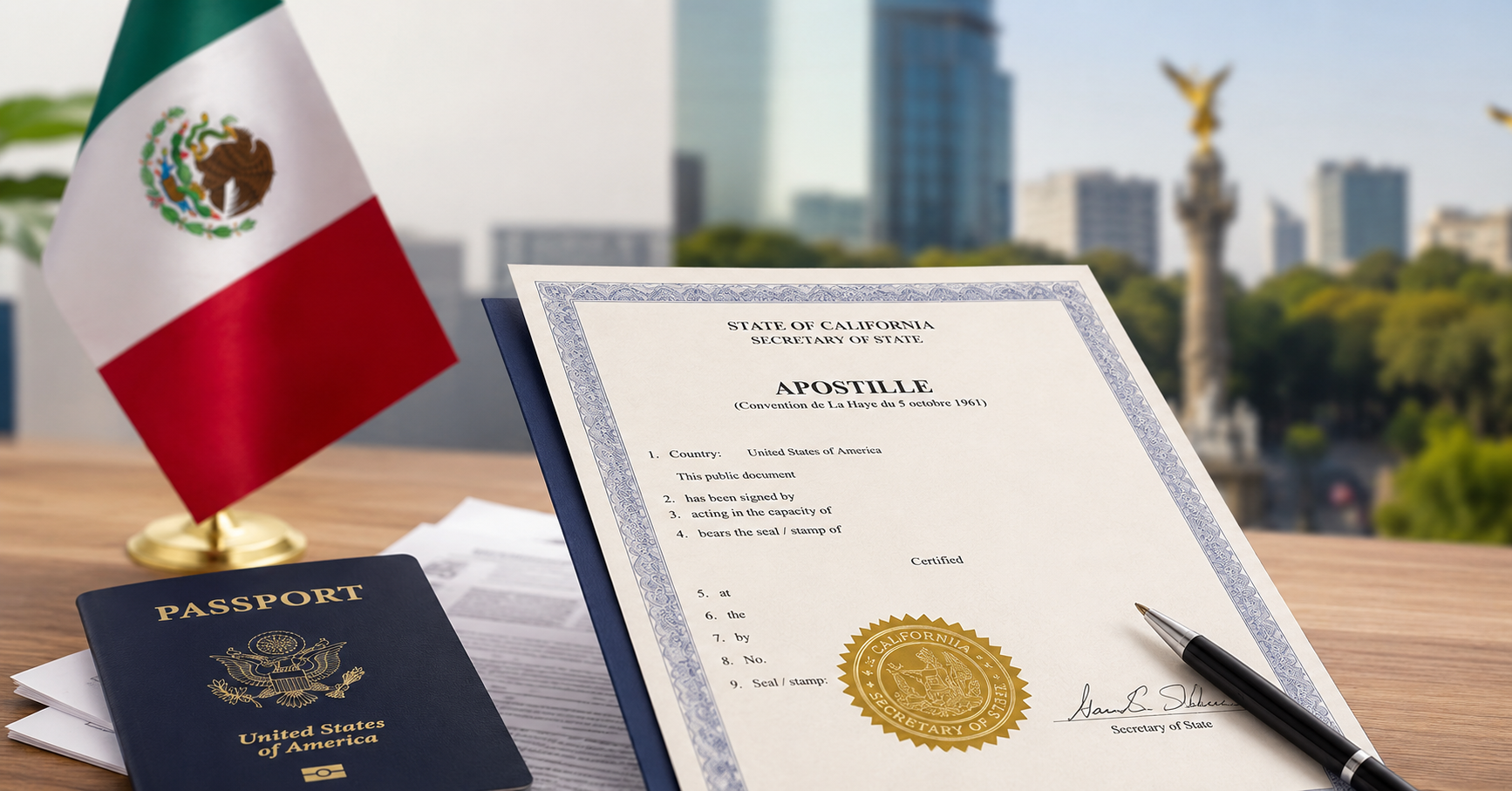

How to apostille a document for use in Mexico.

apostille a document for Mexico

If you need a birth certificate, diploma, marriage record, or corporate document recognized by an authority in Mexico, you will almost certainly be told that the paper needs an apostille. This single word causes more confusion than almost any other term in international document processing, yet the concept is fairly simple once you understand it. This guide walks through exactly how to apostille a document for Mexico, using the same standards and offices that Mexican consulates and government departments rely on when they confirm whether a foreign document is valid for use inside the country.

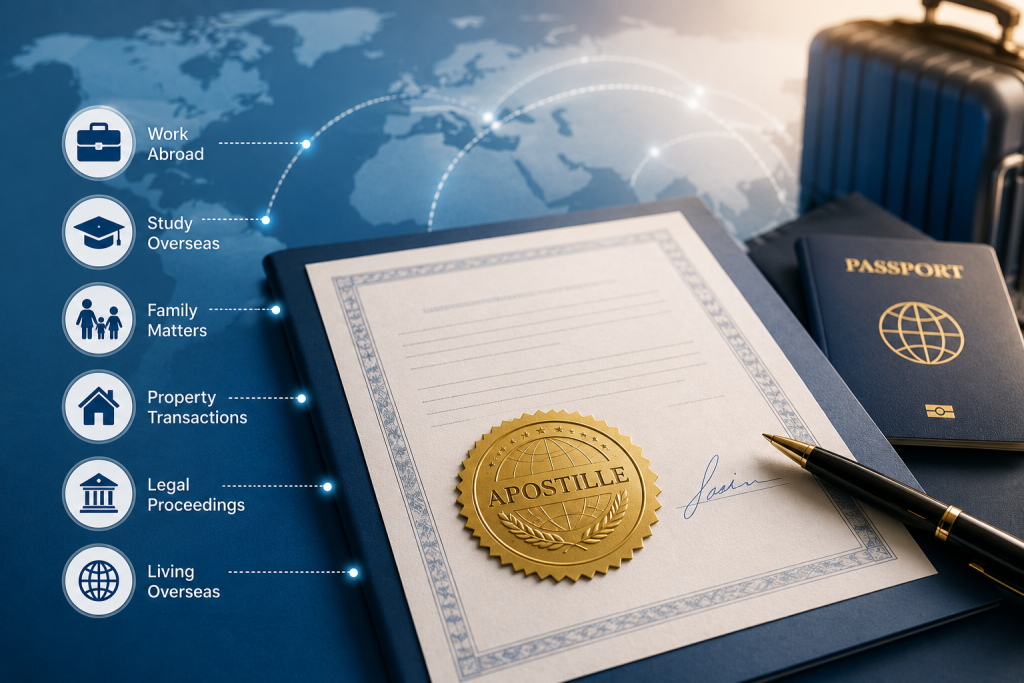
Whether you are relocating for work, getting married in Mexico, enrolling in a Mexican university, opening a business, or handling a legal matter such as an inheritance or a power of attorney, the underlying process is the same. You need a document that a Mexican registry office, court, school, or notary will accept without asking for further proof that it is genuine. An apostille is proof.

What an Apostille Actually Is

An apostille is a certificate issued by a designated government authority that confirms a public document is authentic. It confirms the signature on the document, the capacity in which the signer acted, and, where relevant, the seal or stamp attached to it. It does not certify that the content of the document is true, only that the document itself was issued by a legitimate authority and signed by someone with the power to do so.

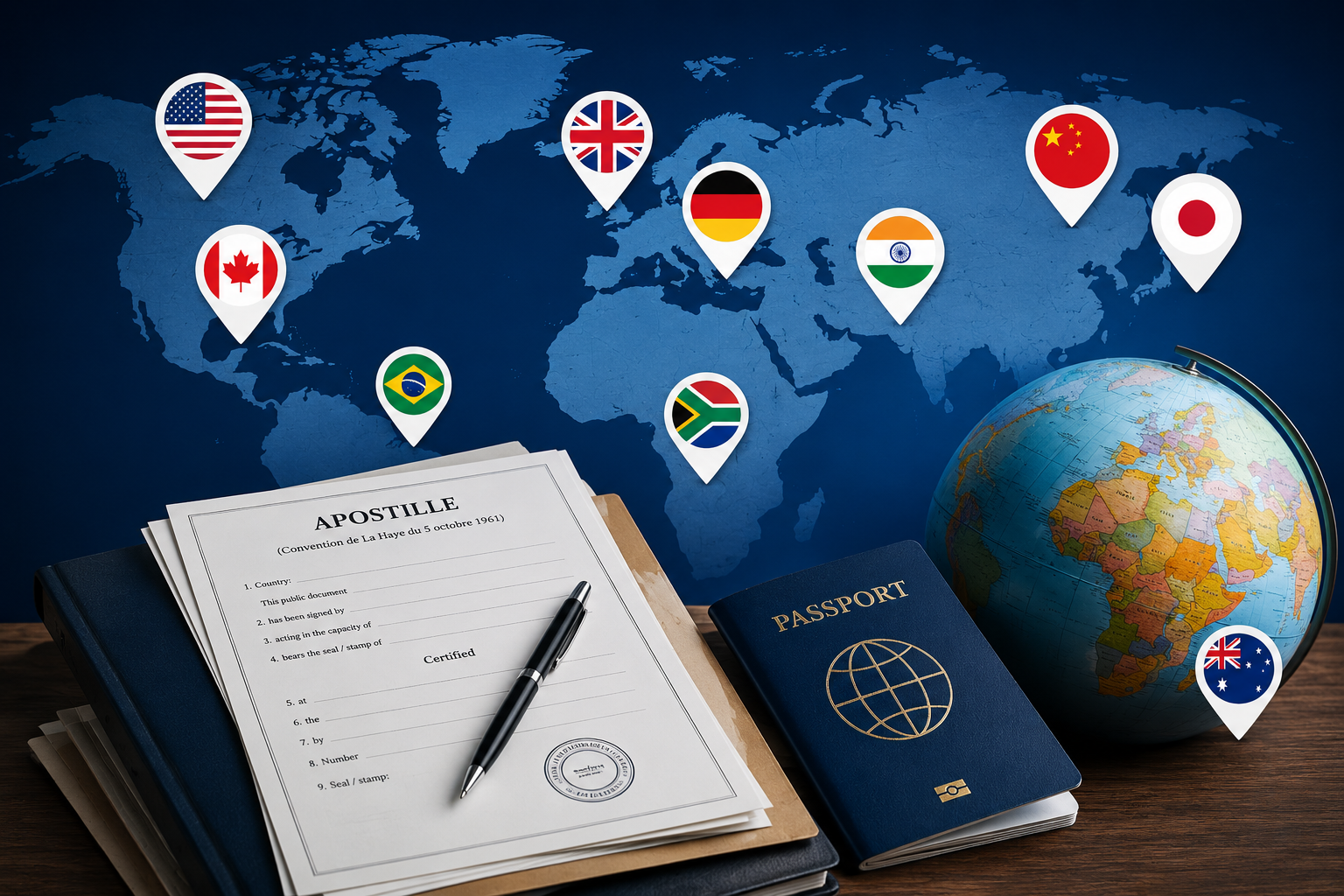
The apostille system exists because of the Hague Convention of 5 October 1961, an international treaty that removed the older, slower requirement of full consular legalisation between member countries. Before this treaty, a document travelling from one country to another often needed to be certified by several different offices, ending with a stamp from the destination country’s embassy or consulate. The apostille replaced that chain with a single certificate recognized by every member state.

People oftenMexico joined the convention and it entered into force there on 14 August 1995. This means that any public document issued in another member country, once apostilled in that country, must be accepted in Mexico without any additional legalisation from a Mexican consulate. This is the exact reason people search for how to apostille a document for Mexico rather than asking how to have a document legalised, since legalisation is a separate and older process reserved for countries that never joined the treaty. Anyone preparing to apostille a document for Mexico should start with this distinction, since it determines every step that follows.

Why Mexico Requires an Apostille

Mexican institutions, from the Registro Civil to universities and notaries, need a fast and reliable way to know that a foreign birth certificate, degree, or affidavit is not fraudulent, which is the whole reason someone needs to apostille a document for Mexico in the first place. Rather than verifying every signature themselves, they rely on the apostille certificate issued in the document’s country of origin. Once that certificate is attached, the Mexican authority treats the underlying document as authentic and moves forward with whatever registration, enrollment, or legal process is being requested.

This is why almost every person dealing with Mexican bureaucracy, whether a foreign national moving to Mexico or a Mexican citizen with documents issued abroad, eventually needs to apostille a document for Mexico before that document will be accepted.

Which Documents Typically Need an Apostille for Mexico

The list of documents that commonly require an apostille for use in Mexico includes the following.

Birth certificates, needed for residency applications, school enrollment, and civil registry matters.

Marriage certificates, required when registering a marriage that took place abroad or when applying for a Mexican marriage license as a foreign national.

Divorce decrees, often requested before a new marriage can be registered in Mexico.

Death certificates, used in inheritance and probate matters.

Academic diplomas and transcripts, needed for university enrollment, professional licensing, and job applications that require credential recognition.

Police clearance or background check certificates are frequently requested for residency permits and certain types of employment.

Powers of attorney, used when someone abroad needs to authorize a representative to act on their behalf in Mexico for property, business, or legal matters.

Corporate documents such as articles of incorporation, certificates of good standing, and board resolutions, needed when a foreign company registers a subsidiary or signs contracts in Mexico.

Single status affidavits, sometimes required alongside a divorce decree or death certificate when applying for a marriage license.

Adoption papers and other family court records are needed for cross-border adoption cases.

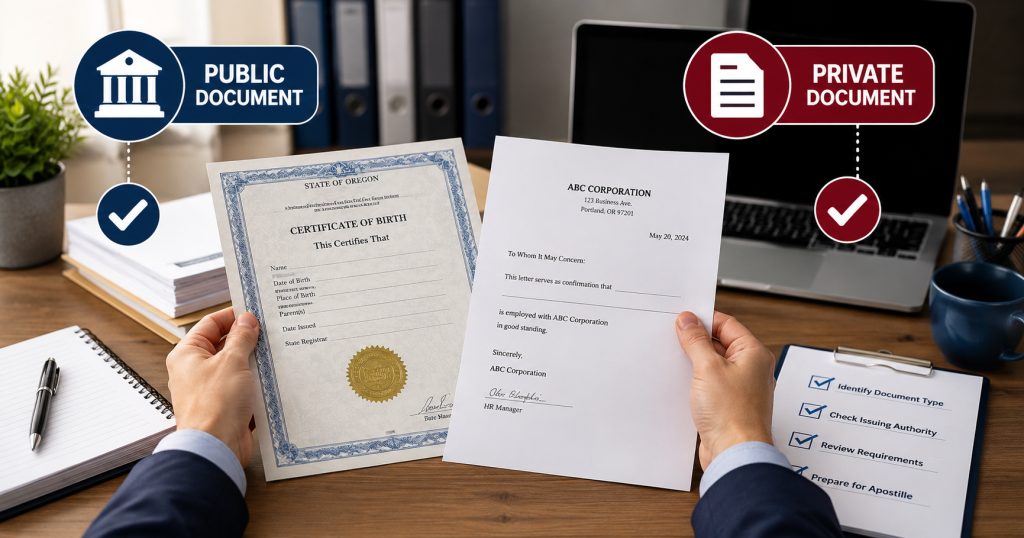
Each of these falls into one of two broad categories. A public document, one issued directly by a government office, court, or vital records agency, can usually go straight to the apostille authority. A private document, such as a document prepared by a company, an individual, or a professional, typically needs to be notarized first so that it becomes eligible for the apostille process.

apostille a document for Mexico

Step One, Confirm the Document Is Eligible

Before anything else, confirm that the paper you are holding is the kind of document that can be apostilled. Only public documents and properly notarized private documents qualify. A photocopy of a document, a document that has already expired, or an informal letter will usually be rejected by the apostille office.

If the document is a vital record such as a birth or marriage certificate, request a certified copy directly from the vital records office or registrar that issued it. Many apostille offices will not accept a certificate that was printed at home or that shows visible signs of alteration. If the document is academic, contact the registrar of the school for an original, sealed transcript or diploma, since photocopies are rarely accepted.

Step Two, Notarize Private Documents

If your document is not a government issued public record, it generally needs notarization before it can move forward. A licensed notary public reviews the signature, confirms the identity of the signer, and applies a notarial seal. This step converts a private document into something the apostille authority can certify, since the apostille itself is only verifying the notary’s signature and seal, not the underlying content.

Common examples include powers of attorney, sworn statements, business letters, and translations prepared by a private translator. Skipping notarization when it is required is one of the most frequent reasons a document is rejected at the apostille stage.

Step Three, Identify the Correct Apostille Authority

This is the step where most confusion happens, because the correct office depends entirely on where the document was issued, not on the fact that it is destined for Mexico.

In the United States, each state has its own apostille authority, almost always the Secretary of State’s office in the state where the document was issued. A birth certificate from Texas must be apostilled by the Texas Secretary of State, while one from California goes through the California Secretary of State. Federal documents, such as an FBI background check, are apostilled by the US Department of State in Washington.

In the United Kingdom, all public documents are apostilled by the Foreign, Commonwealth and Development Office. Private documents such as academic certificates and translations must first be authenticated by a solicitor or notary public before the Foreign, Commonwealth and Development Office will apply the apostille.

In Canada, the process runs through Global Affairs Canada, since Canada joined the Hague Convention more recently and now issues its own apostilles rather than relying on Mexican consular legalisation. Knowing which of these offices applies to your paperwork is the real starting point for anyone trying to apostille a document for Mexico.

If you already hold a Mexican public document that needs an apostille for use in another member country, the process runs in the opposite direction, and the offices involved are different from the ones used to apostille a document for Mexico from abroad. Federal Mexican documents are apostilled through the Secretaria de Gobernacion, specifically the office known as the Coordinacion General Politica con Poderes de la Union in Mexico City. Documents issued by Mexico City authorities go through the Direccion General Juridica y de Estudios Legislativos, and documents issued by any other state go through that state’s Secretaria or Direccion General de Gobierno.

Knowing this distinction matters enormously. People often assume they should contact a Mexican consulate to apostille a document for Mexico, but consulates in member countries generally do not issue apostilles at all. Their role today is limited mainly to non Hague countries, where full legalisation is still required.

Step Four, Submit the Document and Pay the Fee

Once you know the correct authority, the submission process usually involves mailing or delivering the original document along with a completed request form and the applicable fee. Processing times vary widely. Some state offices in the United States turn documents around within a few business days, while others, especially when processed by mail, can take several weeks. The Foreign, Commonwealth and Development Office in the United Kingdom typically advises a similar range, and expedited services are often available for an additional cost.

Fees vary by jurisdiction and document type. If your situation is time sensitive, such as a visa interview or a property closing in Mexico, ask the issuing authority whether expedited or same day service is offered.

Step Five, Arrange a Certified Spanish Translation

An apostille confirms that a document is authentic, but it does not translate the content. Mexican institutions almost always require documents to be presented in Spanish, so once your document has been apostilled you will typically need a certified translation prepared by a qualified translator.

It is important to translate the document only after the apostille has been affixed, since the apostille certificate itself, along with any attached seals, also needs to be reflected in the translation. Some Mexican authorities require the translator to be a “perito traductor” registered with a local court, particularly for use in legal proceedings, so it is worth confirming this requirement with the receiving institution in Mexico before finalizing the translation.

Understanding the Difference Between Apostille and Legalisation

People frequently use these two terms interchangeably, but they describe different processes for different sets of countries. An apostille is a single step certificate used between countries that are both members of the 1961 Hague Convention. Legalisation, by contrast, is a longer chain of authentications used when at least one of the two countries involved has not joined the convention.

Since Mexico has been a member since 1995 and most of its trading partners, including the United States, Canada, the United Kingdom, and the European Union countries, are also members, the overwhelming majority of documents destined for Mexico only need an apostille rather than full legalisation. This is good news for anyone who needs to apostille a document for Mexico, since it means one certificate is usually enough, without a lengthy chain of additional authentications. Confirming your country of origin’s membership status before you begin is a useful first check, since a small number of countries around the world still require the older legalisation route.

Common Mistakes That Delay the Process

Even straightforward requests can be delayed by a handful of avoidable errors.

Sending a photocopy instead of an original certified document is one of the most common reasons an apostille request is returned. Apostille authorities generally require an original or a certified copy, not a scan or a plain reproduction.

Forgetting notarization on a private document is another frequent issue, since the apostille office cannot certify a signature that has not first been verified by a notary.

Translating a document before it has been apostilled often means the translation has to be redone, since the translated version needs to include the apostille certificate itself.

Using an outdated or expired certificate, particularly with police clearance letters, can also cause rejection, since many Mexican institutions only accept documents issued within a set number of months.

Assuming that a Mexican consulate can issue the apostille is another common misunderstanding. In countries that are Hague Convention members, the apostille comes from a domestic government office, not from a Mexican consulate. Most of the delays in this list come down to the same root cause, rushing to apostille a document for Mexico without confirming the right sequence first.

apostille a document for Mexico

How Long the Full Process Usually Takes

Timelines depend on the type of document, the issuing jurisdiction, and whether translation is also required. As a general guide, obtaining a certified copy of a vital record can take anywhere from same day service at a local registrar’s office to several weeks if requested by mail from another state or country. The apostille itself often takes between a few days and three weeks depending on the office and whether expedited service is requested. A certified Spanish translation typically adds a few more business days.

Because these steps happen in sequence, most people should plan for the entire process, from ordering the original document to receiving a translated, apostilled paper ready for use in Mexico, to take anywhere from two to six weeks. Anyone who needs to apostille a document for Mexico on a deadline should factor in this full timeline rather than just the apostille step alone. Building in extra time is especially wise if your document is needed for a fixed date such as a wedding, a court hearing, or a visa appointment.

Special Considerations for Common Situations

Marriage in Mexico. Foreign nationals marrying in Mexico are usually asked for an apostilled birth certificate and, if previously married, an apostilled divorce decree or death certificate. Some Mexican states also require a certified translation and, in certain cases, a single status affidavit.

Residency Applications. Mexican immigration authorities frequently request an apostilled police clearance certificate and, depending on the visa category, apostilled proof of income, marriage, or family relationship documents.

University Enrollment. Mexican universities generally require an apostilled diploma and transcript, along with a Spanish translation, before a foreign academic credential will be recognized for admission or professional licensing purposes.

Business and Property Transactions. Foreign companies establishing a presence in Mexico, or individuals buying property, often need apostilled corporate documents or a properly apostilled and notarized power of attorney so that a representative in Mexico can sign on their behalf. In each of these situations, the underlying task is the same, you need to apostille a document for Mexico before the receiving institution will act on it.

Working With a Professional Apostille Service

Given how many moving pieces are involved, from identifying the correct issuing authority to arranging notarization and certified translation, many people choose to work with a dedicated apostille service rather than manage every step themselves. A professional service can confirm exactly which authority is responsible for your specific document, track it through processing, arrange for a qualified translator familiar with Mexican requirements, and flag any issue, such as an expired certificate, before it causes a delay.

This is particularly valuable for anyone trying to apostille a document for Mexico from overseas, since mailing an original document internationally and coordinating with a foreign government office can be difficult to manage without local knowledge of processing times, fee schedules, and submission requirements.

Frequently Asked Questions

Can a Mexican consulate apostille a document for Mexico?

In most cases no. If your document originates in a country that belongs to the Hague Convention, the apostille must come from a domestic authority in that country, such as a state office or a national foreign affairs department. Mexican consulates generally handle legalisation only for documents coming from countries outside the convention.

How much does it cost to apostille a document for Mexico?

Costs vary by country and document type, and they typically range from a modest government processing fee to a higher amount if expedited service is requested. Working with a professional service adds a service fee on top of the government cost, but it often saves time and reduces the risk of a rejected submission.

Do I still need an apostille if a document was already notarized?

Yes. Notarization and apostille serve different purposes. A notary confirms a signature at the time it was made, while an apostille confirms that the notary themselves was authorized to perform that act. Both steps are usually required for private documents.

Can I complete this process myself without a lawyer?

In many cases yes, since the process is administrative rather than legal. However, identifying the correct authority, avoiding common mistakes, and coordinating translation can be time consuming, which is why many people choose professional help, especially for time sensitive matters.

What happens if my document is rejected?

If a Mexican institution rejects a document, it is usually because of a missing notarization, an outdated certificate, or a translation completed before the apostille was affixed. The good news is that most rejections can be corrected by returning to the appropriate step and resubmitting the corrected document.

Final Checklist Before You Begin

Confirm the document is an original or certified public record, not a photocopy.

Notarize any private document before submitting it for an apostille.

Identify the correct issuing authority based on where the document originated, not on its destination.

Submit the request with the correct fee and allow adequate processing time.

Arrange a certified Spanish translation only after the apostille has been affixed.

Double check any specific requirements from the Mexican institution that will receive the document, since some courts, universities, and civil registries have their own additional rules. Working through this checklist in order is the most reliable way to apostille a document for Mexico without a rejected submission.

Conclusion

Learning how to apostille a document for Mexico comes down to understanding a few core ideas. Mexico has recognized the Hague Apostille Convention since 1995, so nearly every public document issued in a member country only needs a single certificate rather than a lengthy legalization chain. The key is identifying the correct authority in the country where the document was issued, making sure any private document is properly notarized first, and arranging a certified Spanish translation once the apostille has been attached.

Taking the time to prepare each document correctly, in the right order, saves weeks of delay and avoids the frustration of a rejected submission. Whether you are handling a single birth certificate or a full set of corporate documents for a new business, following these steps carefully will help ensure your paperwork is accepted the first time it is presented in Mexico. Once you know how to apostille a document for Mexico, the process becomes far less intimidating each time you need to repeat it.

How to Apostille a Document for Mexico: A Complete Guide

apostille a document for Mexico

If you need to apostille a document for Mexico, the process can feel confusing at first. Between federal offices, state offices, notaries, and certified translators, it is easy to get lost in the paperwork. The good news is that once you understand the steps involved, the process becomes straightforward and predictable. This guide breaks down exactly how to apostille a document for Mexico, based on the official requirements followed by Mexican consular authorities and the Hague Apostille Convention.

Whether you are dealing with a birth certificate, a marriage certificate, a diploma, a power of attorney, or a corporate document, the underlying process to apostille a document for Mexico is largely the same. This article walks you through every stage, explains why each step matters, and highlights common mistakes people make so you can avoid delays.

Why You Need to Apostille a Document for Mexico

Mexico became a member of the Hague Convention of October 5, 1961, which abolished the requirement of legalisation for foreign public documents, on August 14, 1995. Because of this membership, Mexican public documents, along with documents from other member countries, no longer require full consular legalisation. Instead, they only need a simplified certification known as an apostille.

This means that if your home country is also a member of the Hague Convention, you do not need to go through the lengthy embassy legalisation process. Instead, you simply need to apostille a document for Mexico through the competent authority in the country where the document was issued. If your country is not a member of the convention, traditional legalisation is still required, which involves additional steps through consulates and embassies.

Understanding whether your country is a member state is the very first thing you should confirm before you attempt to apostille a document for Mexico. This single detail determines the entire path your document will follow.

apostille a document for Mexico

Step One: Confirm Whether Your Document Is Public or Private

Before you can apostille a document for Mexico, you need to determine what type of document you are working with. Public documents include items such as birth certificates, marriage certificates, death certificates, court orders, and documents issued directly by government offices. These documents are usually ready to be apostilled without any additional preparation.

Private documents are different. These include academic transcripts, diplomas, medical certificates, company records, and translations. Before you can apostille a document for Mexico when it falls into this private category, it must first be authenticated by a solicitor or a notary public. This authentication step confirms that the signature on the document is genuine and that the document itself is legitimate.

Skipping this step is one of the most common reasons applications are rejected. If you attempt to apostille a document for Mexico without first having a private document notarized, the apostille authority will simply send it back, costing you time and money.

Step Two: Identify the Correct Issuing Authority

The next step to apostille a document for Mexico is figuring out exactly which office is responsible for certifying your specific document. This depends heavily on where the document originated.

For documents issued in the United Kingdom, for example, all British public documents must be apostilled by the Foreign and Commonwealth Office. Private documents, once notarized by a solicitor or notary public, are also sent to this same office for certification.

For documents issued in Mexico itself, the process branches depending on whether the document is federal or state level. Federal Mexican public documents are handled by the Coordinación General Política con Poderes de la Unión de la Secretaría de Gobernación. This office manages the certification of documents that originate from federal agencies and institutions.

State level Mexican documents follow a different path entirely. Documents issued by Mexico City authorities go through the Dirección General Jurídica y de Estudios Legislativos del Departamento del Distrito Federal. Documents issued by individual state governments are processed through the Secretaría or Dirección General de Gobierno of that particular state.

If you are trying to apostille a document for Mexico and you are unsure which office applies to your situation, it is recommended that you check with the Secretaría de Gobernación directly, or consult the official list of competent authorities published under the Hague Convention. Getting this detail right the first time will save you significant back and forth.

Step Three: Prepare Your Document Correctly

Once you know which authority will handle your certification, the next step to apostille a document for Mexico is making sure your paperwork is properly prepared. This includes ensuring the document is an original or a certified copy, that all signatures are clear and legible, and that any required notarization has already taken place.

At this stage, many applicants also choose to obtain certified translations if the destination in Mexico requires the document to be presented in Spanish. While the apostille itself certifies the authenticity of the signature, seal, or stamp on the document, it does not translate the content. If your document will be used with an institution that requires Spanish, you should arrange for a certified translation either before or after the apostille process, depending on local requirements.

Taking the time to prepare your document properly before you apostille a document for Mexico prevents unnecessary rejections and keeps the entire process moving smoothly.

Step Four: Submit the Document to the Competent Authority

With your document prepared, you are ready to formally submit it. To apostille a document for Mexico, you will need to send the original document, along with any required application forms and fees, to the relevant office identified in step two.

Some offices, such as the Foreign and Commonwealth Office in the United Kingdom, have moved away from accepting walk in applications. Since April 2011, that office has closed its public counters and only accepts applications submitted by post. This shift toward postal submission is common across many apostille authorities worldwide, so it is worth checking current submission methods before sending anything.

When you submit your documents, include a cover letter clearly stating your name, contact details, the purpose of the apostille, and a note confirming that the document is intended for use in Mexico. This small detail can help avoid confusion during processing.

Step Five: Receive Your Apostilled Document

After your application has been processed, the competent authority will attach or affix the apostille certificate directly onto your document, or onto an attached page. This certificate confirms the authenticity of the signature, seal, or stamp on the original document. Once this certificate is in place, your document is officially ready for use in Mexico without any further legalisation required.

At this point, you have successfully completed the process to apostille a document for Mexico. The certified document can now be submitted to Mexican institutions, courts, universities, immigration offices, or government agencies as needed.

apostille a document for Mexico

What Documents Commonly Need an Apostille for Mexico

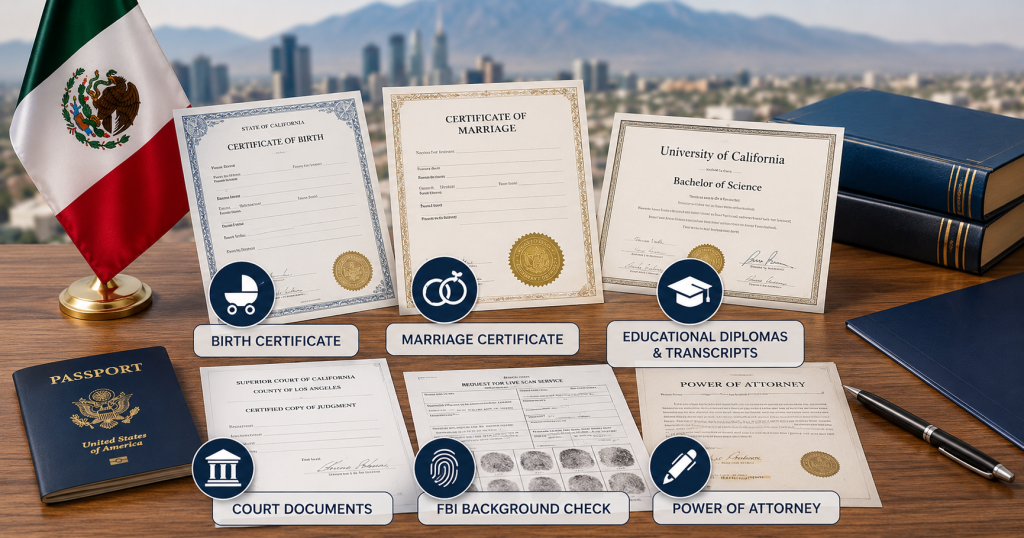
People reach out for help to apostille a document for Mexico for many different reasons. Some of the most common documents include:

Birth certificates, which are often required for residency applications, school enrollment, or family reunification cases.

Marriage certificates, needed for legal recognition of marriage, spousal visas, or property matters.

Academic diplomas and transcripts, required when applying to Mexican universities or seeking professional licensing.

Powers of attorney, used for legal representation in property transactions or business dealings.

Corporate documents, including articles of incorporation, which are often needed when establishing a business presence in Mexico.

Court orders and judgments, which may need to be recognized by Mexican courts in custody, inheritance, or civil matters.

No matter which of these documents you are working with, the underlying process to apostille a document for Mexico follows the same general pattern described in this guide.

Common Mistakes That Delay the Process

Many people run into avoidable delays when trying to apostille a document for Mexico. Understanding these common pitfalls can save you weeks of frustration.

The first mistake is attempting to apostille a private document without first having it notarized. As mentioned earlier, private documents such as diplomas and medical records must go through a solicitor or notary public before they can be certified.

The second mistake is sending documents to the wrong authority. Since Mexico has separate federal and state level offices, sending a state issued document to a federal office, or vice versa, will result in rejection and lost time.

A third common mistake is forgetting that the cited Hague Convention does not apply to certain categories of documents. Specifically, it does not apply to documents executed by diplomatic or consular agents, nor does it apply to administrative documents dealing directly with commercial or customs operations. If your document falls into either of these categories, a different process entirely may be required.

Finally, many applicants forget about translation requirements. Even after you successfully apostille a document for Mexico, the receiving institution may still require a certified Spanish translation before it will accept the document.

How Long Does It Take to Apostille a Document for Mexico

Processing times vary significantly depending on which authority is handling your request and how busy that office currently is. Federal offices in Mexico may process documents within a few business days for straightforward cases, while offices dealing with higher volumes, such as the Foreign and Commonwealth Office in the United Kingdom, may take several weeks, especially since applications must now be submitted by post rather than in person.

If you need to apostille a document for Mexico urgently, it is worth checking whether expedited or priority processing is available through the relevant office. Many services, including professional apostille providers, can also help speed up the process by handling submission, tracking, and follow up on your behalf.

Should You Handle This Yourself or Use a Professional Service

Some people successfully apostille a document for Mexico entirely on their own, especially when dealing with a single, straightforward public document. However, the process becomes considerably more complicated when you are dealing with private documents that require notarization, documents originating from multiple jurisdictions, or time sensitive matters such as visa applications or property closings.

Working with a professional apostille service can remove much of the guesswork. An experienced provider will already know exactly which office handles your type of document, what forms are required, and how to avoid the common mistakes outlined above. This is especially valuable if you are trying to apostille a document for Mexico while living outside the country where the document was issued, since navigating unfamiliar postal systems and government offices from abroad adds another layer of difficulty.

Final Thoughts on the Apostille Process

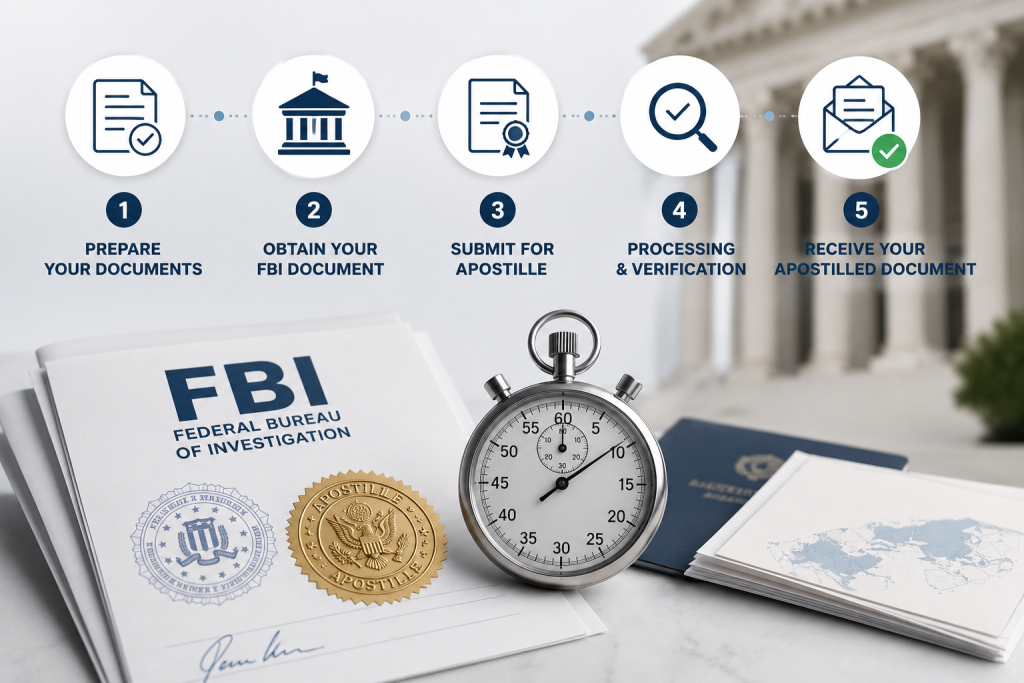
Learning how to apostille a document for Mexico does not need to be overwhelming once you understand the underlying structure. The process comes down to five core steps: confirming whether your document is public or private, identifying the correct issuing authority, preparing your document properly, submitting it to the competent office, and receiving your finished apostille certificate.

Because Mexico is a member of the Hague Apostille Convention, the process is significantly simpler than full legalisation, provided your country of origin is also a member state. Taking the time to verify jurisdiction, complete any required notarization, and arrange translations where necessary will help ensure your document is accepted the first time you submit it.

If you are preparing to apostille a document for Mexico and want expert guidance through every step of the process, working with a dedicated apostille service can help you avoid delays and submit your paperwork with confidence.

How Long Does FBI Apostille Take in 2026?

FBI apostille

If you are planning to use a United States federal background check document abroad, you have likely encountered the requirement for an FBI apostille. Whether you need it for a work visa, residency application, international adoption, or a foreign marriage, knowing exactly how long the process takes in 2026 can save you from serious delays and stress.

This guide breaks down every stage of the FBI apostille process, including realistic timelines, the most common mistakes applicants make, and the fastest strategies available today.


What Is an FBI Apostille and Why Do You Need One?

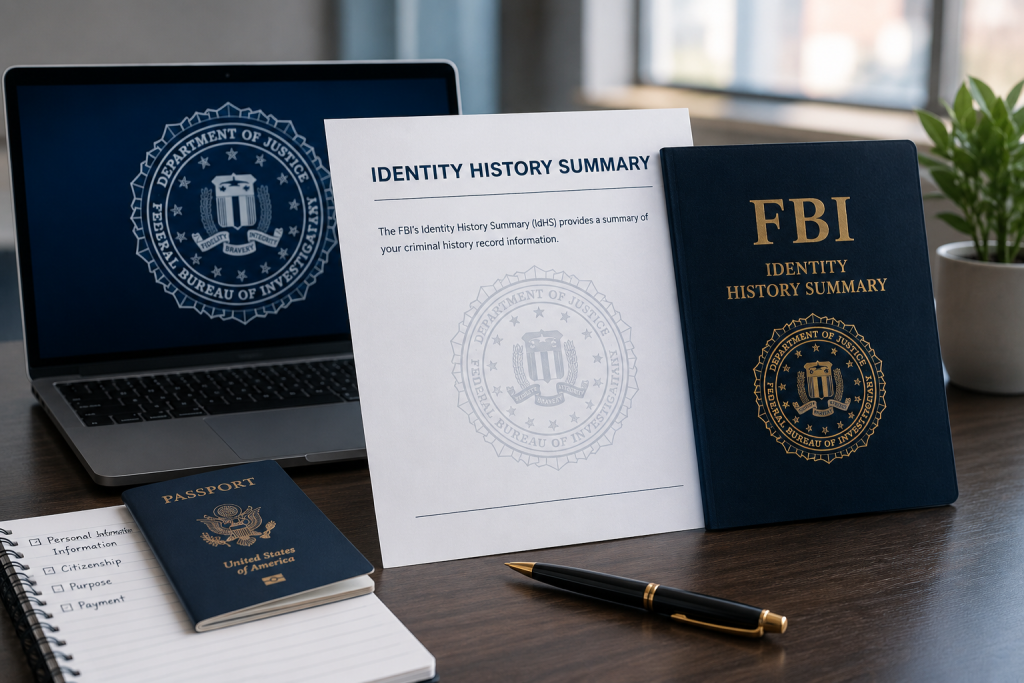
An FBI apostille is an official authentication certificate issued by the U.S. Department of State that verifies the legitimacy of an FBI Identity History Summary, commonly called an FBI background check. Foreign governments that are members of the Hague Apostille Convention require this certification before accepting any U.S. federal document.

The FBI apostille does not change the content of your background check. Instead, it certifies that the signature and seal on the document are genuine, making it legally recognized in over 120 countries around the world.

Without an FBI apostille, your background check will be rejected by foreign consulates, embassies, immigration offices, and government agencies. This means your visa application, residency permit, or employment authorization could be denied or delayed for months simply because your documents were not authenticated properly.

Understanding what an FBI apostille is and why it is required is the first step toward preparing your documents correctly from the very beginning.


How the FBI Apostille Process Works in 2026

The FBI apostille process in 2026 involves two separate government agencies working in sequence. You cannot skip either step, and each one has its own processing timeline that you must account for when planning your submission.

Step One: Obtaining Your FBI Background Check

Before you can request an FBI apostille, you must first have a valid FBI Identity History Summary in hand. The FBI processes fingerprint based background check requests either through a channeler or directly through the FBI Criminal Justice Information Services Division.

If you submit through the FBI directly, processing times in 2026 average between 7 and 10 business days after the agency receives your fingerprint card. Using an FBI approved channeler can reduce this wait to as little as 24 to 72 hours in some cases.

The background check must be in its original form or a certified copy. Photocopies and notarized reproductions are not acceptable when pursuing an FBI apostille through the U.S. Department of State.

Step Two: Submitting for the FBI Apostille

Once your background check is complete, you submit it to the U.S. Department of State’s Office of Authentications for apostille certification. This is the step where your FBI apostille is actually issued, and it is where most of the waiting time occurs for the majority of applicants.


FBI apostille

How Long Does Each Stage Actually Take?

One of the most important things to understand about the FBI apostille process is that you are dealing with two separate agencies on two separate timelines. Here is a realistic breakdown of what to expect in 2026.

FBI Background Check Processing: 7 to 10 Business Days (Direct)

When you submit directly to the FBI, you should expect your background check to be ready within 7 to 10 business days after the agency receives your fingerprint submission. The FBI does not offer an expedited option for direct submissions. If speed is a priority, using a channeler is the smarter route.

FBI Background Check Processing: 24 to 72 Hours (Channeler)

Channelers accredited by the FBI can process your fingerprints and return your background check in as little as one to three business days. This significantly compresses the first stage of the FBI apostille process and is strongly recommended for applicants with urgent deadlines.

U.S. Department of State Apostille Processing: 6 to 8 Weeks (Routine)

In 2026, the U.S. Department of State’s routine processing time for apostille requests, including an FBI apostille, ranges from approximately 6 to 8 weeks. This timeframe can fluctuate based on application volume, staffing, and seasonal demand.

U.S. Department of State Apostille Processing: 5 to 7 Business Days (Expedited)

The State Department does offer an expedited apostille service for an additional fee. As of 2026, expedited FBI apostille requests are typically processed within 5 to 7 business days. This option is ideal for applicants who have a firm visa interview date, an immigration appointment, or a contract signing deadline approaching.

Total Timeline with Standard Processing: 8 to 11 Weeks

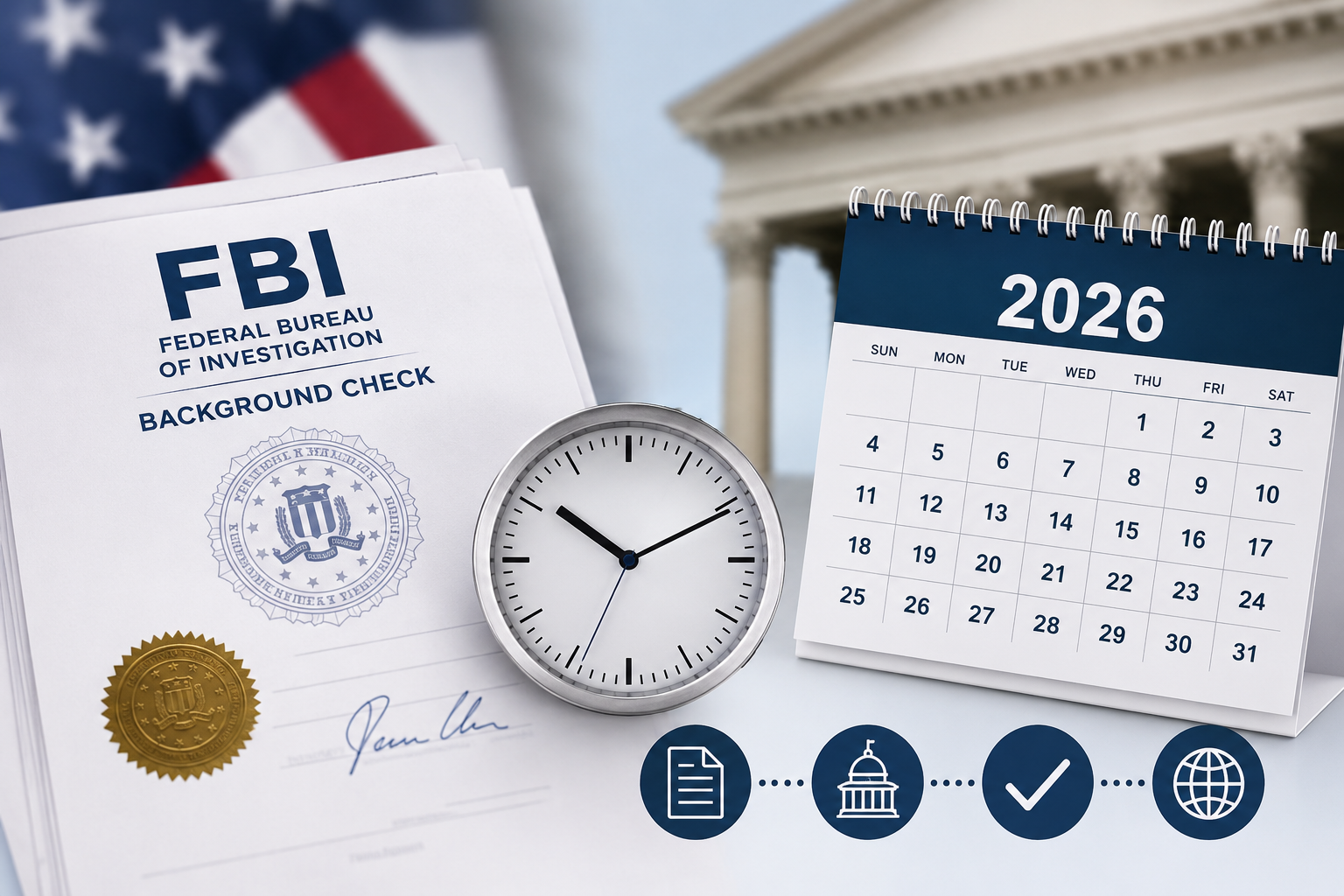
When you add the FBI background check processing time to the State Department apostille processing time and account for mailing in both directions, a standard FBI apostille application from start to finish takes between 8 and 11 weeks in 2026.

Total Timeline with Expedited Processing: 2 to 3 Weeks

Using a channeler for the background check and expedited processing at the State Department, your FBI apostille can be in hand in as little as 2 to 3 weeks, including mailing time.


The 5 Proven Steps to Get Your FBI Apostille Fast

Now that you understand the timeline, here are five actionable steps that will help you obtain your FBI apostille as efficiently as possible.

Step 1: Use an FBI Accredited Channeler for Your Background Check

The single fastest way to compress the FBI apostille timeline is to skip the direct FBI submission route and work with an FBI accredited channeler. Channelers are authorized to submit your fingerprints electronically and receive results directly from the FBI in a fraction of the time it takes for standard mail submissions.

When choosing a channeler, confirm that they are current on the FBI accredited channeler list. Working with an accredited provider ensures your background check is issued in a format that the U.S. Department of State will accept for FBI apostille processing.

Step 2: Choose Expedited Processing at the State Department

Once your background check arrives, do not default to routine State Department processing if your situation has any time sensitivity at all. Paying for the expedited FBI apostille service at the State Department saves most applicants four to six weeks of waiting.

Include all required cover letter information, a self addressed prepaid return envelope, the correct fee, and your original background check. Errors in your submission packet are the leading cause of delays and rejections, so review the State Department requirements carefully before sealing your envelope.

Step 3: Double Check Your Document Before Submitting

A rejected FBI apostille application sets your timeline back significantly. The most common submission errors include sending a photocopy instead of an original, failing to include the correct fee, using an envelope without proper postage, and omitting a cover letter with the required information.

Your FBI background check must bear an original signature or seal from the issuing authority. If your channeler delivers a digital copy, confirm whether a physical certified original is also being sent, because the State Department will not process a photocopy for an FBI apostille.

Step 4: Use a Professional Apostille Service

For applicants who are unfamiliar with the submission requirements or who need a guarantee that the package is prepared correctly the first time, using a professional apostille service is a reliable strategy.

A reputable apostille service handles the entire FBI apostille submission on your behalf. They know the current State Department requirements, they prepare the cover letter, they confirm the document is eligible, and they follow up on the status. While this adds a service fee to your cost, it removes the risk of a rejection that could cost you weeks of additional waiting.

Step 5: Track Your Application and Plan Around Realistic Timelines

After submitting your FBI apostille request, keep a copy of your tracking number if you sent your documents via a trackable mail carrier. The State Department does not provide a real time online tracking tool for apostille requests, so proactive tracking through your carrier is your best visibility into where your package is in the process.

When planning your international application deadlines, always build buffer time around the FBI apostille timeline. Even with expedited processing, unexpected volume spikes at the State Department can add a few business days to your wait. Planning for 3 to 4 weeks in the expedited scenario and 10 to 12 weeks in the standard scenario gives you the cushion you need.


Common Reasons FBI Apostille Applications Are Delayed

Understanding what causes delays in the FBI apostille process is just as important as knowing the timeline. Here are the most frequent reasons applications are held up or returned.

Sending a Copy Instead of an Original

The U.S. Department of State will only process original documents for apostille certification. Sending a photocopy of your FBI background check, even a notarized copy, will result in your application being returned without processing. This alone can add 4 to 6 weeks to your FBI apostille timeline.

Incorrect or Missing Fees

The State Department has specific fee requirements for apostille processing. Submitting an incorrect payment amount or an unacceptable payment method will cause your application to be rejected. Always verify the current fee schedule directly with the State Department before preparing your package.

Missing or Incomplete Cover Letter

Every FBI apostille submission must include a cover letter that contains your contact information, the number of documents enclosed, the type of apostille requested, and a return mailing address. Applications without a proper cover letter are frequently returned unprocessed.

Using an Expired Background Check

Foreign governments and agencies often require that your FBI background check be issued within a specific window, commonly 3 to 6 months, before the date it is submitted as part of your application. If your background check is too old by the time your FBI apostille is issued, you may need to restart the process entirely. Always confirm the recency requirement of your destination country before beginning.

High Volume Periods at the State Department

The State Department’s Office of Authentications experiences surge periods throughout the year, particularly in spring and early fall. During these peaks, even expedited FBI apostille processing can take longer than the standard 5 to 7 business day estimate. Submitting outside of peak periods, when possible, can help you stay within the advertised timeline.


FBI apostille

FBI Apostille vs. State Level Apostille: Knowing the Difference

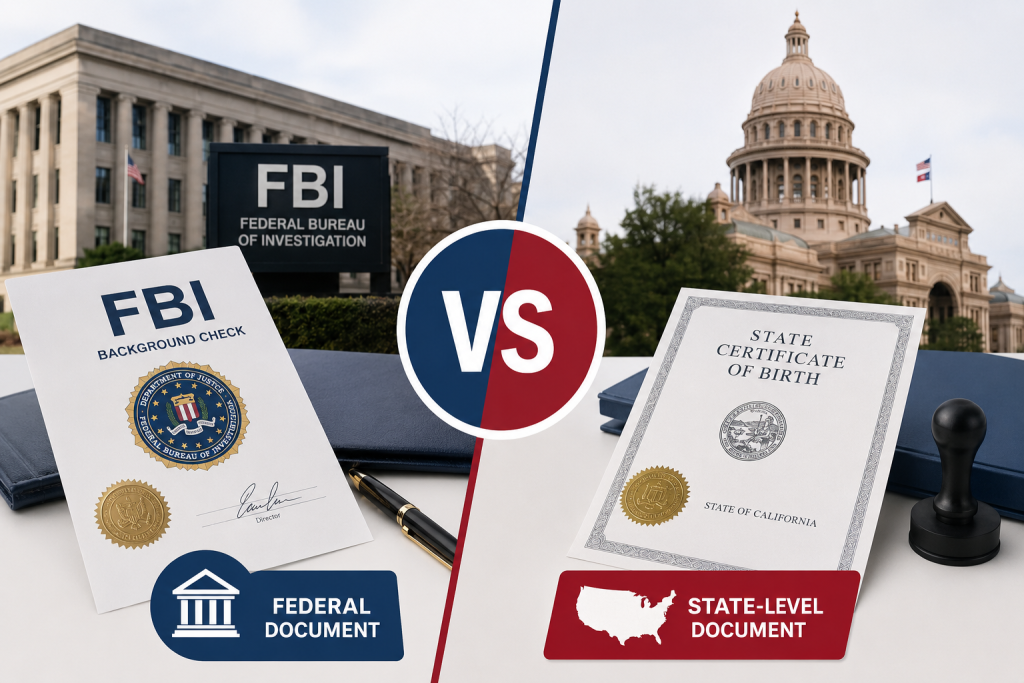
A common source of confusion for applicants is the difference between an FBI apostille and a state level apostille. These are two completely different certifications for two different types of documents.

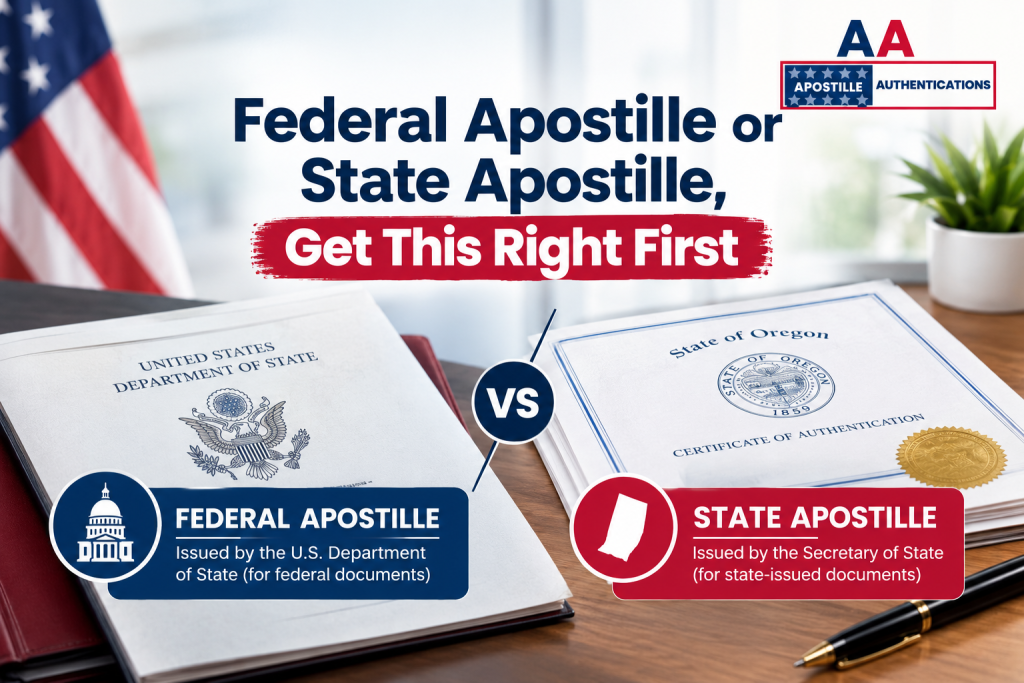
A state level apostille is issued by the Secretary of State’s office in a specific U.S. state and is used to certify state issued documents such as birth certificates, marriage certificates, court records, and notarized documents.

An FBI apostille is issued by the U.S. Department of State specifically for federal documents, and it is required for FBI Identity History Summaries. You cannot take an FBI background check to your state’s Secretary of State office and get an FBI apostille there. The certification must come from the federal level, through the U.S. Department of State.

Knowing this distinction from the beginning will prevent you from wasting time submitting your FBI background check to the wrong agency.


Do You Need Translation with Your FBI Apostille?

In many cases, the country where you are submitting your documents will require a certified translation of your FBI background check in addition to the FBI apostille. The apostille certifies the authenticity of the issuing authority’s signature and seal, but it does not translate the document into the language of the destination country.

If your destination country requires a certified translation, you will need to have the translation completed after the FBI apostille is affixed. Most foreign authorities require that the translation be certified by a professional translation service or a sworn translator recognized in the destination country.

Plan for translation time and cost in addition to your FBI apostille processing time when preparing your full document package.


Is an FBI Apostille Valid Forever?

The FBI apostille itself does not expire. Once the U.S. Department of State certifies your background check, the apostille certification on that document does not have a built in expiration date.

However, the underlying FBI background check is what most foreign agencies scrutinize for recency. If the country or institution you are applying to requires that your background check be no more than 3 or 6 months old, then the age of your background check will effectively determine how long your FBI apostille remains usable in practice.

Always check the recency requirements of your specific destination country or institution. Getting an FBI apostille on a background check that is already close to the recency limit of your destination could mean you need to repeat the entire process sooner than expected.


Why Use a Professional Apostille Service for Your FBI Apostille?

Many applicants attempt the FBI apostille process on their own, only to face rejections, delays, and the frustration of restarting the process from scratch. A professional apostille authentication service eliminates this risk.

At Apostille Authentications, we handle FBI apostille submissions every day. We know exactly what the State Department requires, we confirm document eligibility before submission, we prepare the complete package on your behalf, and we follow up on your application. Our clients avoid the most common mistakes and receive their FBI apostille as quickly as possible.

Whether you need a single FBI apostille or multiple authenticated documents for a complex international application, our team is ready to guide you through every step of the process with precision and professionalism.


Final Thoughts on FBI Apostille Timelines in 2026

Getting an FBI apostille in 2026 takes between 2 and 11 weeks depending on which processing options you choose. Using a channeler for your background check and opting for expedited State Department processing is the fastest legitimate path available, putting a completed FBI apostille in your hands in roughly 2 to 3 weeks.

Avoid the common pitfalls of sending copies instead of originals, submitting incorrect fees, or skipping the cover letter. Understand that an FBI apostille and a state apostille are different certifications handled by different agencies. Factor in translation requirements if your destination country demands them.

Most importantly, start the FBI apostille process earlier than you think you need to. International applications rarely have flexible deadlines, and having your authenticated documents ready well in advance protects you from costly complications.

If you are ready to begin or need expert guidance on your FBI apostille submission, contact Apostille Authentications today. We are here to make sure your documents are prepared correctly and delivered as quickly as possible.

Apostille for Birth Certificate Oregon: 5 Easy Steps to Get It Right in 2026

apostille for birth certificate Oregon

If you need to use your Oregon birth certificate in another country, you will almost certainly need an apostille attached to it. Getting an apostille for a birth certificate in Oregon is the official process that makes your document legally recognized abroad under the Hague Apostille Convention.

This guide walks you through every step of the process in 2026, so you can avoid delays, rejections, and costly mistakes.


What Is an Apostille and Why Does It Matter?

An apostille is a government issued certificate that authenticates the origin of a public document for international use. It does not translate your document and does not certify its content. What it does is verify that the signatures and seals on your document are genuine.

Countries that belong to the Hague Convention of 1961 recognize apostilles as sufficient proof of authenticity. This means if you are moving to Germany, getting married in Mexico, applying for citizenship in Italy, or enrolling in school in South Korea, an apostille for birth certificate Oregon is what you need to make your document valid and accepted.

Without this certificate, foreign authorities will often reject your document outright. That can delay visa applications, immigration filings, school enrollments, and much more.


Who Needs an Apostille for a Birth Certificate in Oregon?

Many people across Oregon need an apostille for birth certificate Oregon every year. Understanding who typically needs this service helps you confirm that you are on the right path before you begin.

You likely need this process completed if you are:

Applying for dual citizenship or foreign nationality based on ancestry. Foreign governments routinely require an authenticated Oregon birth certificate as part of the application.

Getting married abroad. Many countries require proof of single status along with a birth certificate carrying an apostille before they will authorize a marriage ceremony.

Moving abroad for employment. Employers in several countries, particularly in teaching, healthcare, and government sectors, require authenticated identity documents as part of their hiring process.

Enrolling in a foreign university. Academic institutions often require apostilled birth records as part of their international admissions process.

Adopting internationally. International adoption authorities typically require authenticated birth records for all parties involved in the process.

Applying for a long term visa or residency permit. Immigration authorities in many Hague Convention countries require an apostilled birth record as part of the documentation package.

If any of these situations apply to you, getting an apostille for birth certificate Oregon is a required and non negotiable step.


Understanding the Oregon Apostille Process: The Basics

Oregon is a participating state under the Hague Apostille Convention. This means the Oregon Secretary of State has the authority to issue apostilles on Oregon state documents.

For birth certificates specifically, the process has a specific starting point that many people overlook. The apostille is not placed directly on the original birth record you have at home. Instead, you must work with a certified copy issued by the appropriate government authority.

This is one of the most common sources of confusion and delay. Many applicants try to submit their personal copy, only to have it rejected. Understanding this from the start saves time and money.

The Oregon Center for Health Statistics, which operates under Oregon Health Authority, is the state office that issues certified copies of Oregon birth certificates. The Oregon Secretary of State then applies the apostille to the certified copy.


apostille for birth certificate Oregon

Step 1: Obtain a Certified Copy of Your Oregon Birth Certificate

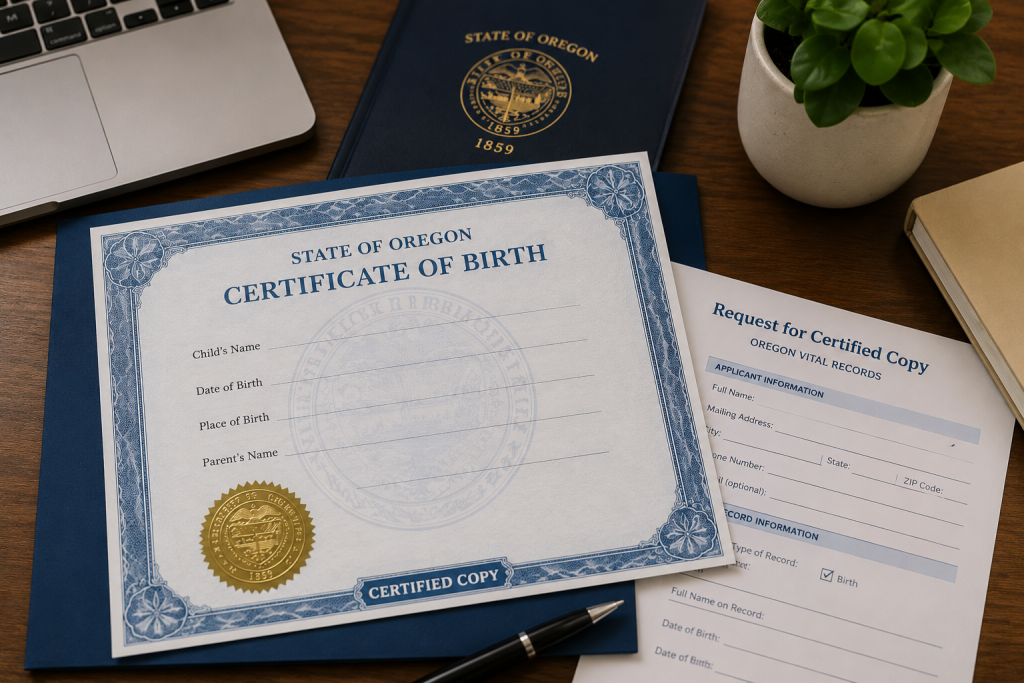
The first step in getting an apostille for birth certificate Oregon is securing a certified copy directly from the Oregon Center for Health Statistics.

A certified copy is not a photocopy of an old document. It is a fresh document issued by the state with an official signature and raised or embossed seal that confirms its authenticity.

You can request a certified copy in several ways.

By mail: Download the Oregon vital records request form from the Oregon Health Authority website, complete it, and mail it with the required fee and proof of identity. Processing times for mail requests typically range from several weeks, depending on the current workload at the office.

In person: You can visit the Oregon Vital Records office in Portland during regular business hours. In person requests are often processed faster than mail requests.

Online: Oregon participates in a third party online ordering system for vital records. While convenient, these services sometimes add additional processing time.

You will need to provide proof of your identity and demonstrate that you are authorized to receive the record. Oregon restricts access to birth certificates to the person named on the record, immediate family members, legal guardians, and authorized representatives.

The fee for a certified Oregon birth certificate is set by the state and is subject to change. Check the Oregon Health Authority website for current pricing before submitting your request.

Once you have your certified copy in hand, you are ready to move to the next step in the apostille for birth certificate Oregon process.


Step 2: Confirm the Document Meets Apostille Requirements

Before submitting your certified copy to the Secretary of State, make sure it meets the requirements for the apostille for birth certificate Oregon to be approved without issue.

The document must carry an original signature from a state registrar or authorized official. The official seal must be present and clearly visible. The signature and seal on the document must match the records on file with the Oregon Secretary of State.

If your certified copy is missing any of these elements, the Secretary of State will reject the apostille request. You would then need to go back and obtain a new certified copy, adding weeks to your timeline.

One practical tip is to avoid folding, laminating, or otherwise altering the certified copy. Documents with creases, tears, or visible damage may also be rejected.


Step 3: Submit Your Document to the Oregon Secretary of State

The Oregon Secretary of State is the state authority responsible for issuing apostilles on Oregon public documents. This is the office where your certified birth certificate goes next.

You have two primary options for submitting your document to the Secretary of State for an apostille for birth certificate Oregon.

By mail: Send the certified copy along with the completed apostille request form and the required fee to the Oregon Secretary of State’s office. The office is located in Salem, Oregon. Include a prepaid return envelope if you want the document sent back to a specific address.

In person: Walk in submissions are accepted during regular business hours. This option allows for faster processing in many cases, as the document does not sit in a mail queue.

The fee for an Oregon apostille varies depending on the number of documents. Check the Oregon Secretary of State website for the current fee schedule before submitting.

Processing times at the Oregon Secretary of State office have ranged historically from a few days to a couple of weeks, depending on volume. During peak seasons, including the spring and summer months, demand often increases and processing times may be longer.

Once the apostille is issued, the Secretary of State attaches a separate apostille certificate to your document. This certificate carries the signature and seal of the Secretary of State and is what foreign authorities recognize as the official authentication.


Step 4: Use a Professional Apostille Service for Speed and Accuracy

While the steps above describe the process you can follow on your own, many Oregonians choose to work with a professional apostille service. This is particularly smart when time is limited, the destination country has complex requirements, or you simply do not want to risk errors.

A professional service that specializes in apostille for birth certificate Oregon can handle the certified copy request, review the document for compliance, submit it to the Secretary of State, and coordinate return shipping, all on your behalf.

Apostille Authentications serves Oregon and Washington clients and offers same-day processing for qualifying documents at offices in Hillsboro, Lake Oswego, Portland, and Vancouver, Washington. For clients who cannot visit in person, mail-in and upload options are also available.

Using a professional reduces the risk of rejection. Errors in the apostille process can be costly. A rejected submission means starting over, which adds weeks to an already tight international deadline.

If your document is needed urgently, same day apostille for birth certificate Oregon service is available for qualifying documents when you call before 10 AM. Apostille Authentications can be reached at (503) 212 0678 or through WhatsApp for fast quotes and appointment scheduling.


Step 5: Verify Requirements With the Destination Country

Before you assume the process is complete, verify that the apostille for birth certificate Oregon meets the exact requirements of the country where you plan to use it.

Different countries have different expectations. Some countries require a translation of the birth certificate into the local language in addition to the apostille. Others require that the apostille be issued within a certain number of months of the date you plan to submit the document.

For example, Spain, Mexico, Germany, and Italy all have their own expectations around apostilled vital records submitted by foreign nationals. What is acceptable in one country may be insufficient in another.

If a translation is required, it must be completed by a certified translator. Apostille Authentications also offers certified document translation services through its partner company Global Doc Translations, which makes it convenient to handle the apostille and translation in one place.

Checking the requirements of the destination country’s consulate, embassy, or relevant government ministry is a critical step. Do this before you start the apostille process so you do not waste time or money going down the wrong path.


Common Mistakes to Avoid When Getting an Apostille for a Birth Certificate in Oregon

Understanding what can go wrong helps you avoid the most frequent and frustrating errors in the apostille for birth certificate Oregon process.

Submitting a personal copy instead of a certified copy is the single most common error. The certified copy must come directly from the state, not from your own records.

Submitting an older certified copy that does not meet current standards is another frequent problem. Some certified copies issued many years ago may not carry the current signature format accepted by the Secretary of State.

Forgetting to include the required fee or the apostille request form is a simple but common oversight that results in delays.

Failing to confirm destination country requirements before starting is a mistake that can result in completing the apostille correctly but still having the document rejected abroad because a translation was missing or the apostille was issued too far in advance.

Rushing through the process without professional guidance when a deadline is approaching often leads to errors that create even longer delays. If your timeline is tight, a professional service is strongly recommended.


How Long Does the Apostille Process Take in Oregon?

Timelines for the apostille for birth certificate Oregon vary based on how you approach each step.

Obtaining a certified birth certificate by mail from Oregon Vital Records typically takes two to four weeks. In person requests can sometimes be completed the same day or within a few business days.

Processing at the Oregon Secretary of State typically takes five to ten business days under normal conditions. Rush and same day options can dramatically shorten this timeline.

If you are working with a professional service like Apostille Authentications, the overall timeline from document request to completed apostille can often be compressed significantly compared to handling each step independently.

For clients with urgent international deadlines, calling ahead to discuss same day or expedited apostille for birth certificate Oregon service is always the best first move.


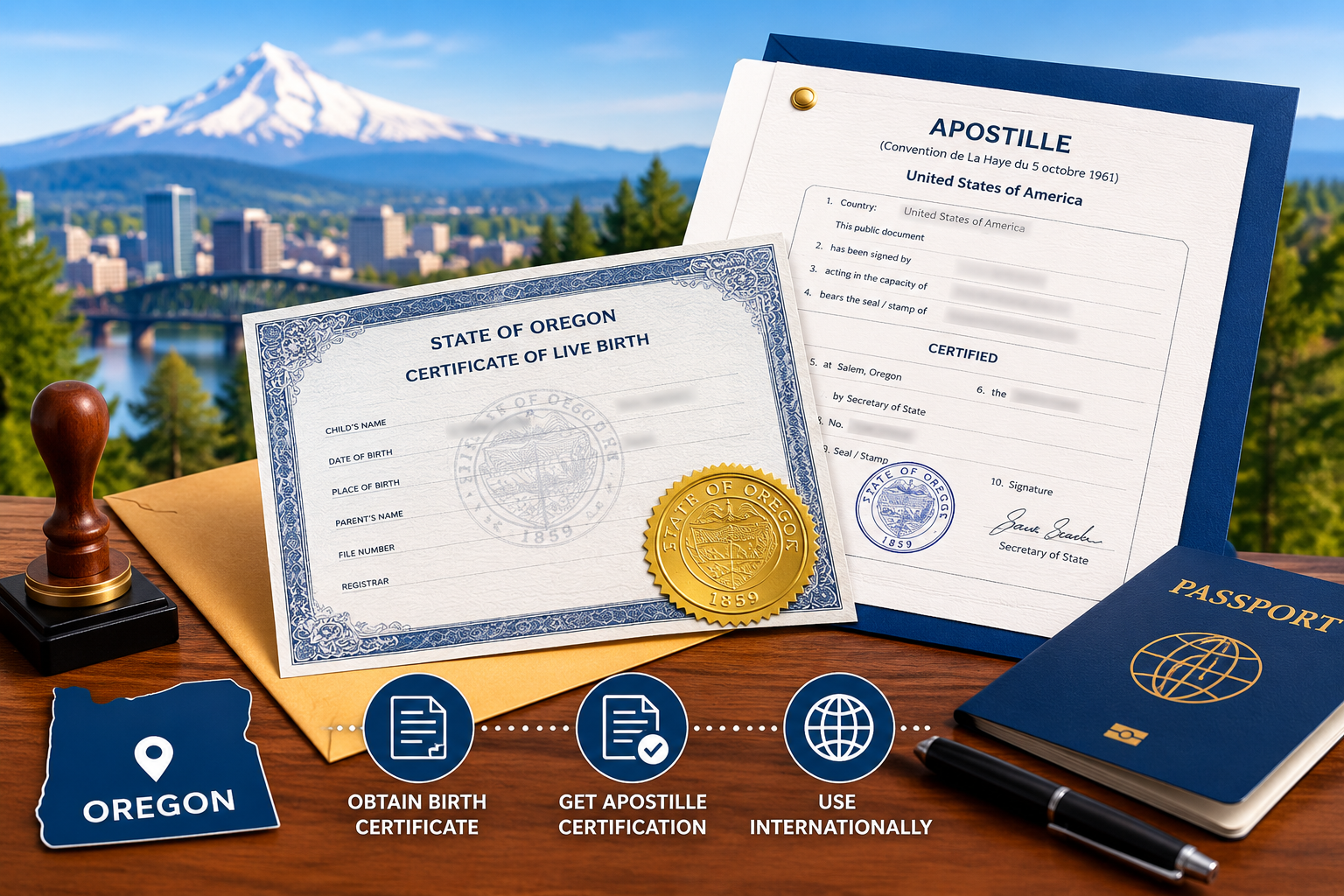
What Does an Oregon Birth Certificate Apostille Look Like?

When the process is complete, you will have two documents. The first is your certified Oregon birth certificate. The second is the apostille certificate itself, which the Secretary of State attaches to the certified copy.

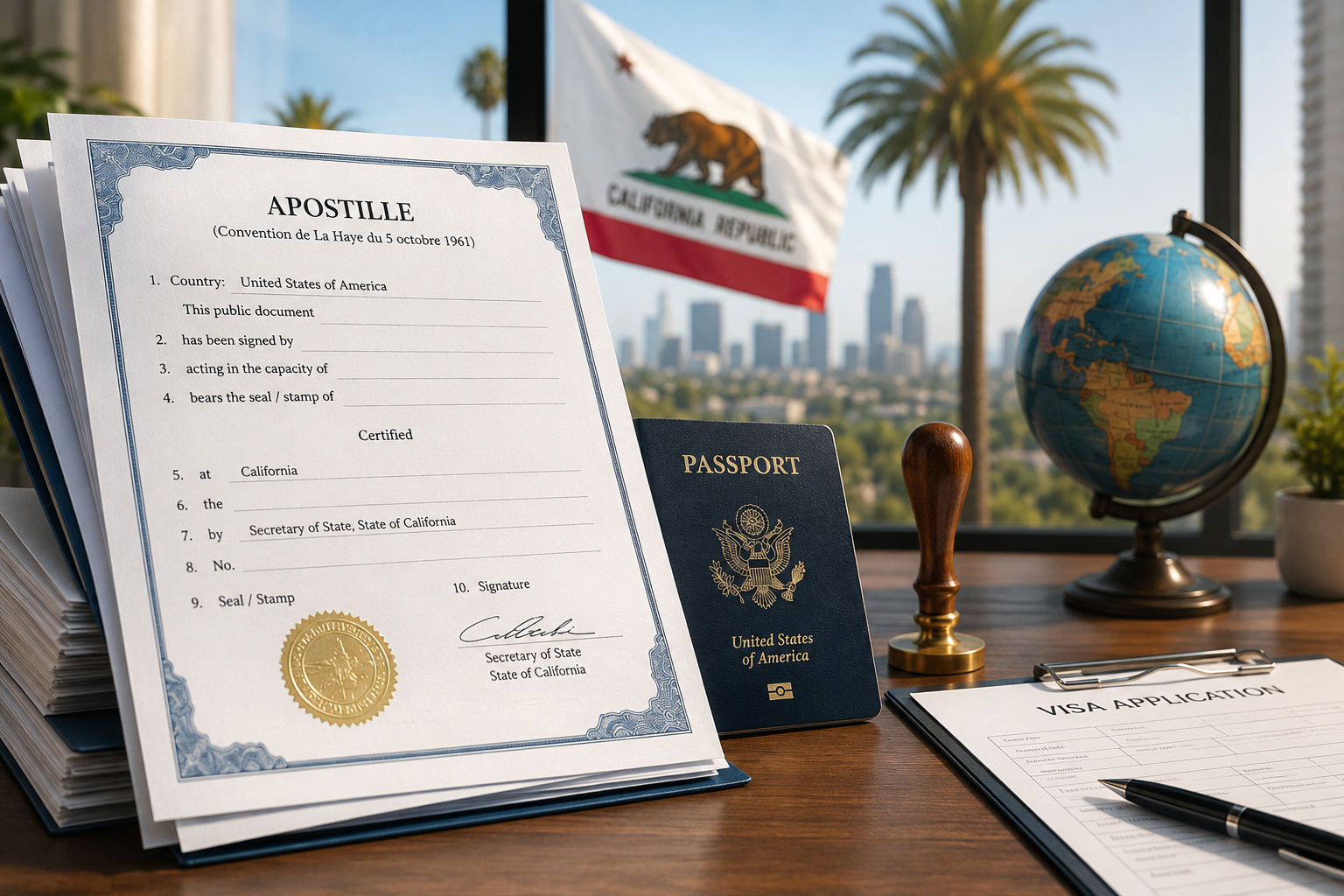
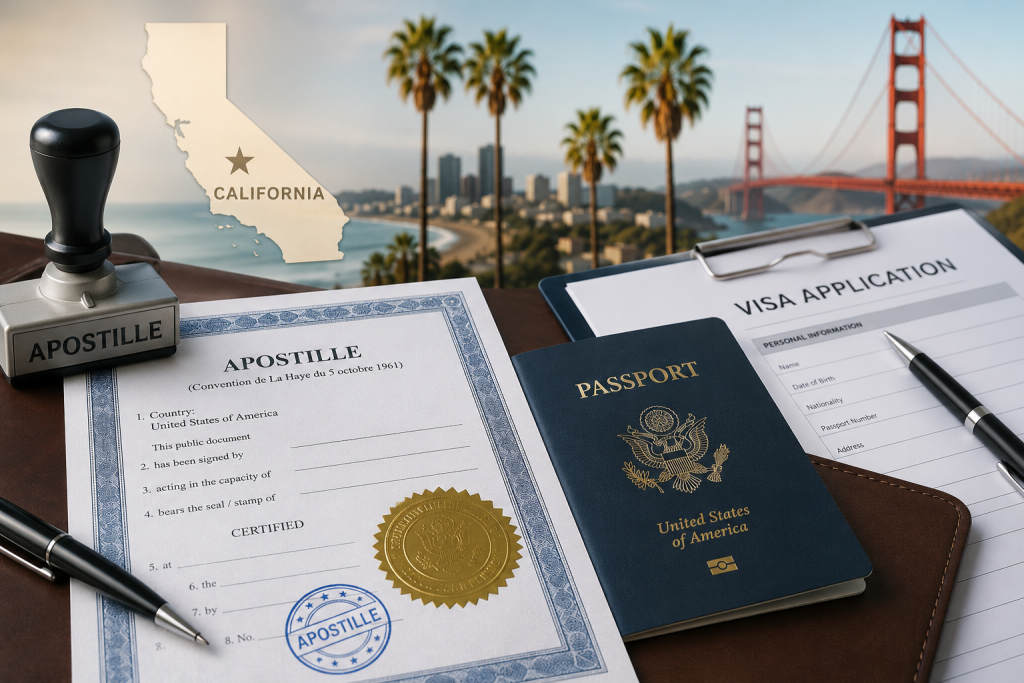
The apostille certificate follows a standardized format established by the Hague Convention. It contains a numbered list of required fields, including the country of issue, the name of the person who signed the document, the capacity in which that person was acting, any seal or stamp on the document, the place and date of issue, the issuing authority, the apostille number, the signature of the issuing authority, and the seal of the issuing authority.

Foreign authorities receiving the apostille for birth certificate Oregon will verify these details against a registry maintained by the Secretary of State to confirm authenticity.


Apostille for Birth Certificate Oregon: Cost Overview

Fees involved in getting an apostille for birth certificate Oregon include:

The certified copy fee from Oregon Vital Records, which is typically set at a base amount per copy with additional fees for rush processing.

The Secretary of State apostille fee, which is charged per document.

If using a professional service, a service fee is charged for handling, coordination, and processing.

Return shipping costs, particularly if you require expedited shipping such as FedEx or international DHL delivery.

Apostille Authentications pricing for state document apostille services starts at $75, with same-day processing available at $195. Translation services through the partner company start at $65 per document. Full pricing details and a quote can be obtained by contacting the office directly.


Frequently Asked Questions About Apostille for Birth Certificate Oregon

Can I apostille an Oregon birth certificate from out of state?

Yes. Mail in services allow clients anywhere in the United States to submit documents for an apostille for birth certificate Oregon. Apostille Authentications accepts mail in requests and ships completed documents via FedEx or USPS to any address.

Does the apostille expire?

The apostille itself does not have a legal expiration date. However, some countries require that the underlying certified copy be issued within a specific period. Always confirm requirements with your destination country.

What if my birth was not registered in Oregon?

If your birth was not registered in Oregon, you cannot obtain an Oregon birth certificate apostille. You would need to work with the state where your birth was registered or explore alternative documentation options such as a late registration.

Can I apostille a foreign birth certificate through Oregon?

No. The Oregon Secretary of State can only apostille documents issued by Oregon state authorities. Foreign birth certificates must go through the appropriate process in the country of origin.


Why Choose Apostille Authentications for Your Oregon Birth Certificate Apostille

Apostille Authentications is Oregon and Washington’s trusted one stop agency for apostille for birth certificate Oregon and a full range of authentication services.

The team handles every step of the process including certified copy coordination, document review, submission to the Oregon Secretary of State, certified translation when required, and secure return shipping.

Offices in Hillsboro, Lake Oswego, Portland, and Vancouver, Washington are available for walk in clients. Mail in and digital upload options serve clients throughout Oregon and all 50 states.

Same-day apostille for birth certificate, Oregon service is available for qualifying documents when you contact the office by 10 AM. The team is reachable seven days a week by phone at (503) 212 0678 and by WhatsApp at (971) 514 3743.

Whether you are facing an urgent international deadline or simply want the process handled professionally from start to finish, Apostille Authentications delivers accurate, fast, and reliable service every time.


Final Thoughts

The apostille for a birth certificate Oregon process has multiple steps, and each one matters. A mistake at any stage can add weeks of delay and create real problems for your international plans.

By understanding exactly what is required, confirming your destination country’s expectations, and working with experienced professionals when needed, you can get your Oregon birth certificate authenticated correctly and on time.

Apostille Authentications is ready to help you every step of the way. Reach out today for a free consultation and same day quote.

FBI Apostille Background Check: 2026 Expert Guide

FBI background check apostille

Getting an FBI background check apostille is one of the most important steps for anyone planning to live, work, study, or retire abroad.

Whether you are applying for a work visa, seeking permanent residency, or enrolling in a foreign university, most countries require a certified FBI criminal history report before they approve your application.

This complete 2026 guide walks you through every step of the process, from requesting your FBI report to getting your FBI background check apostille attached and accepted internationally.


What Is an FBI Background Check Apostille?

An apostille is an internationally recognized certification that authenticates the origin of a public document.

When a foreign government asks for your criminal history, they do not simply accept a printed FBI report. They require proof that the document is genuine and that the signature or seal on it belongs to an authorized U.S. government official.

An FBI background check apostille is the certification placed on your FBI Identity History Summary that verifies its authenticity for use in countries that are members of the Hague Apostille Convention.

Once your document carries this certification, it is legally recognized in more than 120 countries without needing any further authentication.


Who Needs an FBI Background Check Apostille?

You likely need an FBI background check apostille if you are:

Applying for a work visa or employment permit in a foreign country.

Seeking permanent residency or citizenship in another nation.

Enrolling in a foreign university or academic institution.

Getting married abroad and your new country requires a criminal clearance certificate.

Retiring overseas under a residency or pensioner visa program.

Adopting a child internationally, where background checks are a standard legal requirement.

Starting a business in another country that conducts due diligence on foreign nationals.

Nearly every country that participates in the Hague Convention will ask for this document at some stage of your immigration or legal process.


Understanding the Hague Apostille Convention

The Hague Apostille Convention was established in 1961. It created a simplified system for authenticating public documents so they could be used across international borders.

Before the convention, getting a document accepted abroad was a lengthy process involving multiple government agencies, embassies, and consulates.

Today, an apostille from a recognized authority in one member country is enough for the document to be accepted in all other member countries.

The U.S. Department of State is the designated competent authority for issuing apostilles on federal documents, which includes the FBI Identity History Summary.

Your FBI background check apostille goes through the U.S. Department of State before it can be used internationally.


FBI background check apostille

Step One: Obtain Your FBI Identity History Summary

Before you can get an FBI background check apostille, you need the actual FBI report.

The FBI Identity History Summary, also called a criminal history summary or rap sheet, is a record of all fingerprint submissions related to your identity that exist in the FBI database.

There are two ways to request your FBI report.

Option A: Submit Directly to the FBI

You can submit your fingerprints directly to the FBI using their official electronic or ink fingerprint process.

For electronic submissions, you use an FBI approved channeler. These are private companies that the FBI has authorized to collect fingerprints and transmit them electronically.

For ink submissions, you roll your fingerprints on a standard fingerprint card, known as an FD 258 card, and mail it to the FBI along with your payment and a signed Identity History Summary Request form.

Processing times for direct FBI submissions typically range from 3 to 8 weeks, though this can vary depending on current demand and workload.

Option B: Use an FBI Approved Channeler

An approved channeler processes your fingerprints electronically and returns your results much faster, often within 2 to 3 business days.

This is the most popular option for people who are working against immigration or visa deadlines.

A list of FBI approved channelers is available on the official FBI website.


Step Two: Prepare Your Document for Apostille

Once you have your FBI Identity History Summary in hand, the next step is submitting it for apostille authentication.

There are a few things to check before sending your document.

First, make sure your report is an original. The U.S. Department of State does not accept photocopies for apostille purposes.

Second, verify that the document includes a proper certification signature. FBI reports submitted through approved channelers typically come with a certification letter that includes a notarized signature, which is required for the apostille to be attached.

If your document does not have a qualifying signature, it will need to be notarized or certified before it can go to the Department of State.

Third, check the requirements of the destination country. Some countries require your FBI background check apostille to be translated into the local language after authentication. Others may require additional legalization beyond the apostille itself if they are not Hague Convention members.


Step Three: Submit to the U.S. Department of State

The U.S. Department of State Office of Authentications is the federal authority that issues apostilles on federal documents.

To obtain your FBI background check apostille, you submit your certified FBI report to the Office of Authentications along with the required fee and a cover letter that includes your return mailing address and the destination country.

Processing Options

The Office of Authentications currently offers two processing tiers.

Routine processing takes approximately 6 to 8 weeks.

Expedited processing takes approximately 1 to 2 weeks and comes with a higher fee.

You can submit your documents by mail or by in person drop off at their Washington D.C. office if you are located near the area.

What the Apostille Looks Like

The apostille itself is a standardized certificate, typically a stamp or attached page, that includes the name of the signatory, their official capacity, the seal of the issuing authority, the place and date of issue, and a unique identifying number.

This certificate is what foreign governments use to confirm that your document is legitimate.


How Long Does the Entire Process Take?

The total time to complete an FBI background check apostille from start to finish depends on which route you choose.

If you use an FBI approved channeler and pay for expedited processing at the Department of State, you can complete the entire process in as little as 2 to 4 weeks.

If you submit directly to the FBI and use routine processing at the Department of State, the process can take anywhere from 10 to 16 weeks.

Planning ahead is critical. Immigration agencies, foreign employers, and universities typically have hard deadlines, and missing them due to delays in the apostille process can set back your plans significantly.

It is always recommended to start your FBI background check apostille process at least three to four months before your application deadline if possible.


How Much Does It Cost?

Costs for an FBI background check apostille vary depending on the service providers you use.

FBI Identity History Summary

Direct FBI submission costs $18 per request.

Approved channeler fees vary but typically range from $50 to $75 in addition to any fingerprinting fees charged locally.

Fingerprinting

Live Scan fingerprinting fees vary by location and service provider, generally ranging from $20 to $60.

Ink fingerprint card services are often available at law enforcement offices, UPS stores, and private fingerprinting companies for a similar cost.

U.S. Department of State Apostille

Routine processing costs $20 per apostille as of 2026.

Expedited processing carries an additional fee on top of the base rate.

Professional Apostille Service

If you use a professional apostille service like ApostilleAuthentications.com, the entire process is handled on your behalf.

Professional services manage the submission, track your documents, and return the completed FBI background check apostille to you without requiring you to navigate the process alone.


Countries That Commonly Require an FBI Apostille

Many countries request an FBI criminal history report with apostille as part of their immigration or residency process.

Some of the most common destination countries include:

Italy requires a clean criminal record certificate apostille for the elective residency visa and citizenship applications.

Spain requests criminal background clearance with apostille for long term visas and residency permits.

Portugal has made this a standard requirement for its popular D7 passive income visa and the Golden Visa program.

Mexico requires apostilled background checks for temporary and permanent residency applications.

Colombia requests apostilled criminal records for certain visa categories.

South Korea asks for apostilled FBI reports for employment visas in specific industries.

United Arab Emirates requests criminal background clearance as part of the work permit process for many nationalities.

Australia may require an FBI report apostille depending on your visa class and length of stay.

Knowing the specific requirements of your destination country before you begin the process helps you avoid delays and rejections.


Non Hague Convention Countries

Not all countries are members of the Hague Apostille Convention.

If your destination country is not a member, an apostille alone is not sufficient. You will need to go through a process called legalization or authentication, which typically involves:

Getting your document certified by the U.S. Department of State.

Then having it authenticated by the embassy or consulate of the destination country in the United States.

An apostille service provider can advise you on whether your destination country requires legalization instead of or in addition to an apostille.

Always verify the requirements directly with the foreign government or their embassy before submitting your documents.


Common Mistakes to Avoid

Many applicants run into delays or rejections because of avoidable errors in the FBI background check apostille process.

Submitting Photocopies

The Department of State and most foreign governments require original certified documents. Never submit a photocopy.

Using an Expired Report

Many countries set a validity window on background check documents, typically six months from the date of issue. Always check the expiration policy of your destination country before you begin.

Wrong Country Listed on the Cover Letter

The apostille is issued for use in a specific country. If your cover letter lists the wrong destination, your document may be rejected by the receiving government.

Forgetting the Translation Requirement

Some countries require your apostilled document to be translated into their official language by a certified translator. Skipping this step can cause your application to be rejected even after your apostille is in order.

Not Using a Certified Fingerprint Provider

The FBI only accepts fingerprints that meet specific quality standards. Using an uncertified fingerprint provider can result in rejected submissions and delays.


Why Use a Professional Apostille Service?

Navigating the FBI background check apostille process on your own is entirely possible, but it comes with risks.

Government processing times fluctuate. Requirements change. Submission errors lead to rejection without refund of your time or fees.

A professional apostille service removes these risks.

At ApostilleAuthentications.com, we handle the entire authentication process from document verification to Department of State submission and final delivery.

Our team stays current on all federal processing requirements, country specific rules, and translation needs so your documents are prepared correctly the first time.

We track your documents throughout the process and keep you informed every step of the way.

Whether you need a single apostille urgently or you are coordinating a full package of documents for an international move, we are equipped to help.


Frequently Asked Questions

How long is an FBI apostille valid?

The apostille itself does not expire, but many countries require that the underlying FBI report be issued within the past six months. Always check with the receiving country for their specific validity requirements.

Can I get an apostille on an FBI report I already have?

Possibly. It depends on how the report was issued and whether it carries the necessary certification. Reports issued through an approved channeler with a notarized letter are typically eligible. Contact a professional service to review your existing document before submitting.

Does every country accept an FBI apostille?

Countries that are members of the Hague Apostille Convention accept it. Countries that are not members require a different process called legalization. Always verify before you apply.

What if my FBI report shows a record?

An apostille certifies the authenticity of your document, not its content. If your report shows a criminal history, it will be apostilled and submitted as is. Immigration outcomes depend entirely on the policies of the destination country.

Can I apostille other documents at the same time?

Yes. If you need apostilles on birth certificates, marriage certificates, or other federal or state documents, many apostille services can handle multiple documents in a single order.


Final Thoughts

The FBI background check apostille process is one of the most critical steps in any international immigration, employment, or residency application.

Understanding the steps, planning your timeline carefully, and avoiding common errors will help you move through the process efficiently and without costly setbacks.

If you want the process handled by experts who manage these submissions every day, visit ApostilleAuthentications.com to get started.

We make sure your documents are prepared, submitted, and delivered correctly so you can focus on the next chapter of your journey abroad.

Apostille Countries: The 2026 Essential Complete List

Apostille countries

If you are preparing documents for international use, knowing which apostille countries belong to the Hague Convention is one of the most important things you can do.

Without this knowledge, your paperwork could get rejected, delayed, or sent through a much longer legalization process.

This guide gives you a current, reliable breakdown of all apostille countries as of 2026, including recent additions, notable exceptions, and what to do if your destination is not on the list.


What Is an Apostille and Why Does It Matter?

An apostille is an official government certification that authenticates a public document for use in another country.

It was created under the 1961 Hague Convention, formally known as the Convention Abolishing the Requirement of Legalisation for Foreign Public Documents.

When a document carries an apostille, any of the other member apostille countries must recognize it as legally valid without additional embassy certification.

This saves enormous time and cost for individuals, businesses, and legal professionals.

The apostille does not verify the content of a document. It only confirms that the signature, seal, or stamp on the document is genuine.


How Many Apostille Countries Exist in 2026?

As of April 2026, there are 129 contracting parties to the Hague Apostille Convention.

This number has grown significantly over the past few years, making it easier than ever to use authenticated documents across borders.

Notable recent additions include China, which joined effective November 7, 2023, Canada, which joined effective January 11, 2024, Rwanda, which joined effective June 5, 2024, and Bangladesh, which joined effective March 30, 2025.

Viet Nam deposited its instrument of accession on December 31, 2025, and will officially become a full member with effect from September 11, 2026.

These additions reflect a growing global shift toward streamlined document authentication, which benefits millions of people working, studying, and traveling internationally.


The Complete List of Apostille Countries in 2026

Below is a full regional breakdown of all nations currently recognized under the Hague Convention as of 2026.

Europe

Europe is home to the largest concentration of members in the world. Every EU member state belongs to the Convention, along with most non-EU nations.

Albania, Andorra, Austria, Belarus, Belgium, Bosnia and Herzegovina, Bulgaria, Croatia, Cyprus, Czech Republic, Denmark, Estonia, Finland, France, Georgia, Germany, Greece, Hungary, Iceland, Ireland, Italy, Kosovo, Latvia, Liechtenstein, Lithuania, Luxembourg, Malta, Moldova, Monaco, Montenegro, Netherlands, North Macedonia, Norway, Poland, Portugal, Romania, Russia, San Marino, Serbia, Slovakia, Slovenia, Spain, Sweden, Switzerland, Ukraine, and the United Kingdom are all active members.

This wide coverage means that a document apostilled in one European nation is recognized across all others without any additional steps.


The Americas

North America, Central America, South America, and the Caribbean are all well represented among recognized apostille countries.

In North America, the United States, Canada, and Mexico are all members. Canada only joined in January 2024, which surprised many professionals who assumed it had long been part of the network.

In Central America, Belize, Costa Rica, El Salvador, Guatemala, Honduras, Nicaragua, and Panama are all members.

In South America, Argentina, Bolivia, Brazil, Chile, Colombia, Ecuador, Guyana, Paraguay, Peru, Suriname, Uruguay, and Venezuela all belong to the Convention.

The Caribbean nations of Antigua and Barbuda, Barbados, Dominica, Dominican Republic, Grenada, Saint Kitts and Nevis, Saint Lucia, Saint Vincent and the Grenadines, Trinidad and Tobago, and the Bahamas round out this region.


Asia and the Pacific

Asia has seen remarkable growth in membership over recent years.

In East and Southeast Asia, China (including Hong Kong and Macau through territorial extension), Japan, South Korea, Mongolia, Brunei Darussalam, and the Philippines are all active members.

In South Asia, India, Pakistan, and Bangladesh are all part of the network. Bangladesh joined in March 2025, making it one of the newest members.

In Central Asia, Armenia, Azerbaijan, Kazakhstan, Kyrgyzstan, Tajikistan, Turkmenistan, and Uzbekistan are all recognized members.

In the Pacific, Australia, Cook Islands, Fiji, Marshall Islands, New Zealand, Niue, Palau, Samoa, Tonga, and Vanuatu are all parties to the Convention.


Africa

Africa has a smaller but steadily growing presence on the list.

Botswana, Burundi, Cape Verde, Eswatini, Lesotho, Liberia, Malawi, Mauritius, Namibia, Rwanda, Sao Tome and Principe, Seychelles, South Africa, and Zimbabwe are all current members.

Rwanda joined in June 2024, reflecting continued expansion across the African continent.


The Middle East and North Africa

Participation is more limited in this region, but several key nations are members.

Bahrain, Israel, Jordan, Morocco, and Oman are all part of the Convention.

It is important to note that several of the region’s most frequently visited destinations, including the UAE and Saudi Arabia, are not part of the recognized apostille countries network. Documents intended for those destinations still require embassy attestation.


Apostille countries

Which Nations Are NOT on the List?

Knowing which nations fall outside the framework is just as important as knowing which ones are inside it.

Major non-members as of 2026 include the UAE, Saudi Arabia, Indonesia, Egypt, and several others across Africa and Southeast Asia.

For these destinations, a standard apostille is not sufficient. Documents must go through consular legalization or embassy attestation instead.

This process typically involves authentication at the state or federal level, followed by verification through the U.S. Department of State, and then submission to the destination country’s embassy or consulate.

The process is longer, more expensive, and requires careful attention to requirements that vary by country.


What Documents Can Be Apostilled?

Once you confirm that your destination is among the recognized apostille countries, the next question is which documents qualify.

Apostilles can be placed on public documents, which cover a wide range of official papers.

Common documents sent abroad include birth certificates, marriage certificates, divorce decrees, death certificates, educational diplomas and transcripts, notarized affidavits, corporate documents, powers of attorney, court records, and background checks.

Documents that are purely private, such as personal letters or contracts between individuals, generally cannot receive an apostille unless they have first been notarized by a public official.

Once notarized, the notary’s signature itself becomes a public document eligible for authentication.


How to Use This Apostille Countries List for Your Documents

Start by identifying the country where your document was issued and the country where it will be used.

If both countries are among the recognized apostille countries, you are eligible for the simplified apostille route.

Contact the competent authority in the issuing country to begin the apostille process. In the United States, that is typically your state’s Secretary of State office.

If the destination is not among the apostille countries, contact the relevant embassy or a professional document service to determine what legalization steps are required.

When in doubt, working with a professional apostille service ensures your documents are processed correctly, quickly, and without costly errors.


Why Working With a Professional Apostille Service Matters

Navigating the requirements of 129 apostille countries on your own can be overwhelming.

Requirements change. New apostille countries join the Convention. Processing times shift. Document standards vary by state and country.

A trusted apostille service stays current on all these changes and handles every step on your behalf.

Whether you need documents apostilled for business registration in Europe, academic enrollment in Latin America, residency applications in Asia, or legal proceedings across any of the apostille countries, professional guidance makes the entire process faster and more reliable.

At Apostille Authentications, we specialize in processing documents for all apostille countries quickly and accurately.

Our team handles every type of document, every state, and every destination country in the Convention.


Final Thoughts on Apostille Countries in 2026

The network of apostille countries continues to grow every year, making international document authentication more accessible than ever before.

With 129 members as of 2026, the chances are high that your destination country is among the recognized apostille countries.

But confirmation is always worth it before you begin.

Verify your destination against the official HCCH status table, prepare the correct documents, and work with a professional service to make sure everything is handled properly.

If you need help apostilling documents for any of the apostille countries, contact Apostille Authentications today for fast, expert service you can trust.

Apostille Authentication Service: 3 Key Differences You Must Know Today

apostille authentication service

If you have ever needed to use a document in a foreign country, you have probably heard terms like apostille, authentication, and notarization thrown around.

These three processes sound similar. They are not.

Mixing them up can delay your visa, stall your business deal, or even get your documents rejected at a foreign embassy.

This guide breaks down exactly what each process means, when you need it, and how a trusted apostille authentication service can make the entire experience far less stressful.


What Is Notarization?

Notarization is the most basic level of document verification available in the United States.

A notary public is a state-appointed official who verifies the identity of the person signing a document. The notary then stamps and signs the document to confirm that the signature is genuine.

This is where the process starts, but it does not go very far on its own.

Notarization confirms who signed a document. It does not verify the content of the document, and it carries no legal weight outside the country.

Common documents that require notarization include affidavits, powers of attorney, real estate deeds, and financial agreements.

If you are using a document only within the United States, notarization may be all you need.

But the moment that document needs to cross a border, notarization alone is rarely enough.


What Is Authentication?

Authentication is a multi-step process that goes beyond notarization.

After a document is notarized, it must be certified at several levels of government before it can be accepted in certain countries.

The typical authentication chain in the United States looks like this:

First, the document is notarized by a state-commissioned notary public. Then, the notary’s signature is certified by the county clerk or the state’s Secretary of State. After that, the U.S. Department of State authenticates the document at the federal level. Finally, the embassy or consulate of the destination country places its own seal on the document.

This final step, known as legalization or consular authentication, is what makes the document legally usable in that specific foreign country.

Authentication is required for countries that are not members of the Hague Apostille Convention of 1961.

If you are sending documents to countries in parts of Asia, the Middle East, or Africa, you will likely need full authentication rather than an apostille.

This is a longer, more complex process, which is exactly why many individuals and businesses turn to a professional apostille authentication service to handle it on their behalf.


What Is an Apostille?

An apostille is a specialized certificate issued by a government authority that verifies the authenticity of a public document for use in another country.

The apostille was introduced under the Hague Convention of October 5, 1961, and it applies only between the countries that are members of this convention.

Currently, more than 120 countries are members of the Hague Apostille Convention.

When a country is a member, the apostille acts as a streamlined form of authentication. It eliminates the need for the lengthy multi-step embassy legalization process.

Instead, one single apostille certificate is attached to your document, and it is recognized directly by the destination country.

The apostille itself includes the name of the country issuing it, the name of the person who signed the document, the title of the person who stamped or sealed the document, the name of the city where the document was issued, the date of issue, and a unique identifying number.

In the United States, apostilles are issued by the Secretary of State in each state, or by the U.S. Department of State for federal documents.

An apostille authentication service handles all the submission, tracking, and delivery so you receive a certified document without unnecessary delays.


The Core Differences at a Glance

Understanding the differences between these three processes is critical before submitting any international documents.

Notarization is a domestic verification of a signature. It is performed by a notary public. It carries legal weight only within the United States and has no international recognition on its own.

Authentication is a chain of certifications required for documents going to countries outside the Hague Apostille Convention. It involves multiple government agencies and embassies. It is the most time-consuming option.

Apostille is a single-certificate verification required for documents going to countries that are members of the Hague Apostille Convention. It is faster than full authentication and is widely accepted across more than 120 countries.

A reliable apostille authentication service will first determine which process your specific document requires before proceeding with any filings.


apostille authentication service

When Do You Need an Apostille?

You need an apostille when you are sending documents to a country that is part of the Hague Convention and that country requires official verification of your document.

Common situations where people seek an apostille authentication service include:

Studying abroad. Universities in countries like Spain, Italy, Germany, and Brazil require apostilled academic transcripts, diplomas, and background checks before accepting international students.

Getting married overseas. Many countries require apostilled birth certificates, proof of single status, and other civil documents before they will permit a foreign national to marry on their soil.

Starting a business internationally. Companies expanding into Hague Convention member countries need apostilled articles of incorporation, powers of attorney, and financial documents.

Adopting a child from another country. International adoptions require extensive apostilled documentation to satisfy both the home country and the destination country.

Working abroad. Employment visas often require apostilled background checks, degrees, and professional certifications.

Retiring overseas. Retirees applying for long-term residency visas in places like Portugal, Mexico, or Panama are frequently asked to provide apostilled pension letters, bank statements, and birth certificates.

In every one of these situations, an apostille authentication service reduces the burden by navigating the paperwork requirements on your behalf.


When Do You Need Full Authentication Instead?

If the country where you plan to use your document is not a member of the Hague Apostille Convention, you will need to go through the full authentication process instead.

Countries like China, Kuwait, the United Arab Emirates, Vietnam, and several others have not joined the Hague Convention.

For these destinations, your documents must pass through the complete chain: notary, state certification, federal certification, and then consular legalization at the embassy or consulate of the destination country.

This process can take weeks, sometimes longer, depending on the embassy’s workload and the type of document involved.

A professional apostille authentication service that also handles consular legalization can coordinate all of these steps simultaneously and keep the timeline as short as possible.

Knowing whether your destination country is in the Hague Convention is the very first step, and it determines everything else that follows.


What Types of Documents Can Be Apostilled?

Not every document qualifies for an apostille. Only public documents are eligible.

Public documents include birth certificates, death certificates, marriage certificates, divorce decrees, court judgments, educational diplomas and transcripts, notarized private documents, government-issued background checks, and corporate documents issued or notarized by government officials.

Private documents, like personal letters, resumes, or privately drafted contracts, must first be notarized by a notary public before they can be submitted for an apostille.

A knowledgeable apostille authentication service will advise you on whether your document qualifies as a public document, whether it needs notarization first, and which government office has authority to issue the apostille for your specific document type.


How Long Does the Process Take?

Processing times vary widely depending on the type of document, the issuing state, and whether you are requesting an apostille or full authentication.

State-level apostilles typically take anywhere from a few days to several weeks, depending on the Secretary of State’s current workload. Some states offer expedited processing for an additional fee.

Federal apostilles for documents issued by U.S. federal agencies are processed by the U.S. Department of State’s Office of Authentications, and standard processing can take two to three weeks.

Full authentication for non-Hague countries takes longer still, often four to eight weeks, depending on the embassy involved.

When you use an apostille authentication service, expedited options are usually available. The service has established relationships with government offices and knows how to prioritize your submission to reduce turnaround time.


Common Mistakes to Avoid

There are several costly mistakes that people make when attempting to handle apostille or authentication on their own.

Submitting the wrong document type. Some countries require an original certified copy, not a photocopy. Others accept notarized copies. Submitting the wrong format will result in rejection and delays.

Missing the signature chain. Authentication requires every signature along the chain to be certified in the correct order. Skipping a step, even accidentally, invalidates the entire document.

Failing to check the destination country’s requirements. Requirements differ not just by country but sometimes by the specific purpose of the document. A marriage certificate submitted for a visa application may have different requirements than the same certificate submitted for a residency permit.

Using an expired document. Many countries specify that documents must have been issued within a certain timeframe. An apostille authentication service will flag outdated documents before submission.

Trusting unofficial intermediaries. Not all document service providers are accredited or reputable. Always work with a verified apostille authentication service that has transparent pricing, clear timelines, and verifiable customer reviews.


Why Use a Professional Apostille Authentication Service?

Handling apostille or authentication requests independently is possible, but it is rarely the most efficient path.

Government offices have specific requirements for how documents must be submitted, what fees are required, and how returns are processed. One small error at any point in the chain can result in rejection and force you to start over.

A professional apostille authentication service understands every detail of this process.

They know which documents require state-level processing versus federal processing. They know which states allow online submissions and which require in-person filing. They track your documents from submission to return. They alert you if any issues arise.

For individuals, using an apostille authentication service means less time spent researching confusing government procedures and more time focusing on the actual reason you need the document in the first place.

For businesses, an apostille authentication service becomes a reliable partner for handling the volume of international documentation that grows with your expansion.


Choosing the Right Apostille Authentication Service

Not all services are created equal. When choosing a provider, look for the following qualities.

Experience and specialization. A service that focuses exclusively on document authentication and apostille processing will have deeper expertise than a general legal document service.

Clear communication. You should receive regular updates on the status of your documents. An apostille authentication service that leaves you in the dark is not worth your time or money.

Knowledge of international requirements. Requirements change. Embassies update their procedures. Countries join or leave conventions. Your service provider should stay current on all of these changes so you do not have to.

Transparent pricing. There should be no hidden fees. Government filing fees, courier costs, and service charges should all be clearly disclosed upfront.

Positive track record. Look for verified reviews and testimonials from real customers who have used the apostille authentication service for situations similar to yours.

At ApostilleAuthentications.com, our apostille authentication service is built around transparency, speed, and accuracy. We handle every step of the process so your documents arrive correctly certified and on time.


Final Thoughts

Notarization, authentication, and apostille are three distinct processes designed for three distinct purposes.

Notarization verifies a signature for domestic use. Authentication certifies a document for use in non-Hague countries through a chain of government and embassy approvals. An apostille provides streamlined international certification for use in Hague Convention member countries.

Getting the right process the first time saves you time, money, and a great deal of frustration.

Whether you are a student, a professional, a business owner, or someone planning a major life event abroad, working with a trusted apostille authentication service is the smartest decision you can make when your documents need to cross borders.

Ready to get started? Visit ApostilleAuthentications.com and let our apostille authentication service take the complexity out of international document certification.

What Are the Common Apostille Mistakes to Avoid? A Complete Guide

apostille mistakes

Navigating the apostille process can be confusing, especially when international deadlines loom. Understanding common apostille mistakes helps you avoid costly delays, rejections, and the frustration of starting over. Whether you’re authenticating documents for work abroad, international adoption, or overseas education, knowing what can go wrong protects your timeline and investment.

At Apostille Authentications in Oregon, we’ve helped thousands of clients successfully authenticate their documents. This comprehensive guide shares the most frequent errors we encounter and how to prevent them.

Understanding the Apostille Process

An apostille is an official certification that verifies the authenticity of documents for international use. The Hague Convention of 1961 created this simplified authentication method for documents traveling between member countries.

The apostille certificate confirms that signatures, seals, and stamps on your documents are genuine. Without proper apostille authentication, foreign governments and institutions will reject your paperwork. This affects visa applications, business registrations, marriage licenses, and educational enrollment.

Each state has designated authorities responsible for issuing apostilles. In Oregon, the Secretary of State handles most document types, while certain federal documents require authentication through the U.S. Department of State in Washington, D.C. Avoiding an apostille mistakes ensures your documents are processed correctly and on time.

Mistake #1: Submitting Documents to the Wrong Authority

One of the most common apostille mistakes involves sending documents to incorrect agencies. Not all documents receive apostilles from the same office, and choosing wrongly wastes valuable time and money.

State-issued documents like birth certificates, marriage licenses, divorce decrees, and corporate records require state-level apostille certification. Your Secretary of State’s office handles these authentication requests following specific procedures.

Federal documents including FBI background checks, naturalization certificates, and certain patent documents need authentication through the U.S. Department of State. These cannot receive state apostilles regardless of where you submit them.

Educational documents present particular confusion. Some diplomas and transcripts qualify for state apostille, while others require additional steps. Knowing the issuing authority helps prevent common apostille mistakes.

Before submitting anything, verify which agency has jurisdiction over your document type. Professional apostille services like ours eliminate this guesswork by routing documents correctly from the start.

Mistake #2: Forgetting Required Notarization

Many documents need notarization before receiving an apostille. Skipping this critical step represents a frequent error that causes immediate rejection and processing delays.

Powers of attorney, affidavits, contracts, and personal statements all require notary certification before apostille authentication. The notary public verifies the signer’s identity and witnesses the document execution, creating the foundation for apostille certification.

The apostille authenticates the notary’s signature and commission, not the document content itself. Without proper notarization, there’s nothing for the apostille authority to verify, making certification impossible.

Ensure your notary public holds a current commission in the same state where you’ll request the apostille. Avoiding common apostille mistakes is crucial, as an Oregon notary’s signature cannot receive apostille authentication from California’s Secretary of State.

Some documents like certified vital records already contain official signatures and seals, eliminating notarization requirements. Birth certificates, death certificates, and marriage licenses issued by government offices typically qualify for direct apostille placement.

Mistake #3: Using Uncertified or Photocopied Documents

Apostille authorities only authenticate original documents or certified copies issued by authorized agencies. Regular photocopies, scanned documents, and uncertified duplicates will always face rejection.

Birth certificates must be certified copies from the vital records office, not hospital-issued commemorative certificates. Many apostille mistakes happen when keepsake versions lacking official seals and signatures are submitted.

For educational credentials, you’ll need official transcripts sent directly from the school or certified copies bearing the institution’s original seal. Avoid common apostille mistakes, as photocopies from your personal files won’t qualify regardless of how authentic they appear.

Corporate documents require certification from the Secretary of State’s office where the business registered. Articles of incorporation, certificates of good standing, and operating agreements need official certification before apostille processing.

When ordering vital records or educational transcripts, specify that you need them for international use requiring apostille authentication. Many issuing offices understand this requirement and provide appropriately certified versions.

Mistake #4: Failing to Verify Destination Country Requirements

Not every country participates in the Hague Apostille Convention. Sending apostilled documents to non-member nations represents a significant error with no simple remedy.

Countries outside the convention require different authentication procedures called legalization. Avoiding apostille mistakes is crucial, as this multi-step process involves state authentication, U.S. Department of State certification, and embassy legalization from the destination country.

Before starting the apostille process, confirm your destination country’s membership in the Hague Convention. Current member nations accept apostille certification, while non-members need traditional document legalization.

Some countries maintain additional requirements beyond basic apostille authentication. They might require specific formatting, translations, or supplementary certifications. Research destination country requirements thoroughly or consult professional authentication services.

International adoption, foreign business registration, and overseas employment often involve multiple document types with varying requirements. Understanding each document’s specific needs helps prevent costly apostille mistakes and processing delays.

Mistake #5: Incorrect or Missing Translations

Foreign governments typically require documents in their official language. Submitting English-only documents without proper translation creates immediate complications and possible rejections.

Translation requirements vary significantly between countries. Avoiding common apostille mistakes is essential, as some accept apostille placement on English documents with separate certified translations, while others require translation before apostille authentication or on both original and translated versions.

Using unqualified translators represents a common mistake. Most countries require certified translations from professional translators or translation services. Your neighbor who speaks Spanish fluently cannot provide acceptable certified translations for legal purposes.

The translation certification itself often needs notarization before receiving an apostille. This creates a multi-step process: original document apostille, professional translation, translation certification, notarization of translator’s certificate, and apostille on the translation certification.

Understanding your destination country’s translation requirements before beginning saves time and prevents rejections. Professional apostille services coordinate translation and authentication in the correct sequence.

Mistake #6: Rushing Without Allowing Adequate Processing Time

Underestimating apostille processing timelines can lead to unnecessary stress and costly apostille mistakes. Standard processing through Secretary of State offices typically takes 1–3 weeks, though timelines vary by state and season. Rush services exist but cost significantly more, and expedited options may reduce processing to 24–48 hours, though availability isn’t guaranteed during high-volume periods.

FBI background checks for international use require fingerprinting, FBI processing, and then apostille authentication. This combined process can take 6-8 weeks or longer. Planning for adequate time prevents panic and expensive last-minute solutions.

Educational institutions may need several weeks to prepare official transcripts. Government offices processing vital record requests operate on their own schedules. Factor these preliminary steps into your overall timeline.

Starting the apostille process early allows for unexpected complications. If documents get rejected for technical reasons, you’ll have time to correct issues and resubmit without missing critical deadlines.

Mistake #7: Incomplete or Incorrect Application Information

Submitting apostille requests with missing information or errors causes processing delays and potential rejections. Each apostille authority maintains specific application requirements that must be followed precisely.

Common application mistakes include incomplete contact information, missing payment, unclear instructions about return shipping, and failure to specify the document type or destination country.

Some states require specific request forms while others accept letter requests. Using the wrong format or omitting required fields triggers processing delays while clerks contact you for clarification.

Payment errors also create problems. Incorrect amounts, wrong payment methods, or missing payment information halt processing immediately. Verify current fees and accepted payment types before submitting requests.

Return shipping instructions need particular attention. Specifying your preferred carrier, providing prepaid labels when required, and including adequate postage for document return prevents delivery problems.

apostille mistakes

How Professional Apostille Services Prevent Mistakes

Professional apostille authentication services eliminate common errors through expertise and experience. We understand each state’s requirements, proper document preparation, correct agency jurisdiction, and destination country specifications.

Our team reviews documents before submission, identifying potential issues early. We ensure proper notarization, verify document authenticity, confirm correct certification, and route submissions to appropriate authorities.

For FBI background checks and federal documents, we manage the entire process including fingerprinting coordination, FBI submission, document retrieval, and Department of State authentication.

We maintain relationships with Secretary of State offices and understand current processing times. This allows accurate timeline estimates and appropriate service level selection based on your deadline requirements.

Translation coordination represents another valuable service component. We work with certified translators and manage the authentication sequence ensuring translations receive proper apostille certification.

State-Specific Considerations for Oregon Apostilles

Oregon’s Secretary of State processes most apostille requests through their Notary Public and Apostille division. Understanding Oregon-specific procedures helps prevent state-level mistakes.

Oregon accepts mail-in requests, walk-in service by appointment, and submissions through authorized apostille service providers. Each submission method follows different procedures and timelines.

Payment requirements include specific fees for standard and expedited processing. Oregon accepts various payment methods but maintains strict guidelines about acceptable formats and amounts.

The Secretary of State authenticates documents notarized by Oregon-commissioned notaries and vital records issued by Oregon agencies. Out-of-state documents cannot receive Oregon apostille certification.

For federal documents like FBI background checks, Oregon residents still must submit through the U.S. Department of State in Washington, D.C. These cannot receive state-level apostille authentication.

Conclusion

Avoiding common apostille mistakes requires understanding authentication requirements, proper document preparation, and careful attention to procedural details. The most frequent errors involve wrong agency submission, missing notarization, uncertified documents, destination country misunderstandings, translation issues, inadequate timelines, and incomplete applications.

Professional apostille services provide valuable expertise preventing costly mistakes and delays. At Apostille Authentications, we handle FBI background check apostilles and document authentication throughout Oregon and nationwide.

Our experienced team ensures proper document preparation, correct agency submission, and timely processing. We eliminate guesswork and frustration from the apostille process while protecting your international deadlines.

Whether you need apostille authentication for adoption, employment abroad, international business, or educational purposes, we’re here to help. Visit https://apostilleauthentications.com/ or contact us today to discuss your document authentication needs.

Understanding these common apostille mistakes empowers you to navigate the process successfully. With proper preparation and professional guidance, your documents will receive correct authentication for international acceptance.

Does an FBI background check need to be notarized for an apostille?

FBI apostille notarization

Understanding FBI apostille notarization requirements can be confusing for those navigating international document authentication. The short answer is no—FBI background checks typically do not need notarization before obtaining an apostille. However, the complete picture involves several important considerations that affect how you prepare your documents for international use.

At Apostille Authentications in Oregon, we specialize in helping clients navigate the complex world of document legalization. This comprehensive guide explains everything you need to know about FBI apostille notarization and getting your FBI background check authenticated for use abroad.

Understanding FBI Apostille Notarization Basics

An FBI background check, officially known as an Identity History Summary, is a federal document issued directly by the Federal Bureau of Investigation. The question of FBI apostille notarization stems from confusion about document authentication requirements.

The FBI issues these background checks on official letterhead with a unique document number and authorized signature. Because the FBI is a federal agency, their documents carry inherent authenticity that doesn’t require additional notarization.

An apostille is a certificate that authenticates the origin of a public document for use in countries that are members of the Hague Apostille Convention. The apostille certifies the signature, seal, or stamp on the document as genuine.

For FBI background checks, the apostille is issued by the U.S. Department of State in Washington, D.C. This is the only authority that can apostille federal documents, including FBI Identity History Summaries.

Understanding this distinction is crucial when determining if FBI apostille notarization is part of your document preparation process or if you can proceed directly to authentication.

FBI apostille notarization

Why FBI Apostille Notarization Isn’t Required

Federal documents like FBI background checks already possess the official seals and signatures necessary for apostille authentication. FBI apostille notarization is generally unnecessary because notarization serves a different purpose.

Notarization verifies that a person signing a document is who they claim to be and that they signed voluntarily. FBI background checks are not personally signed documents—they’re official reports generated by a federal agency.

The FBI seal and the authorized signature of FBI officials provide the authentication needed for the U.S. Department of State to issue an apostille. Adding notarization wouldn’t enhance the document’s legitimacy and could actually complicate the process.

Some individuals mistakenly believe FBI apostille notarization is mandatory because they’ve had to notarize other documents for international use. State-issued documents like birth certificates or diplomas may require different authentication steps.

The key is understanding that federal documents follow a different authentication pathway than state or locally issued documents. This distinction determines whether FBI apostille notarization is part of your document preparation process.

The Correct Process for FBI Apostille Authentication

Obtaining an apostille for your FBI background check involves specific steps that don’t typically include FBI apostille notarization. First, you must request your FBI Identity History Summary directly from the FBI.

You can obtain your FBI background check through several methods: online through an FBI-approved channeler, by mail using fingerprint cards, or through an FBI-authorized live scan facility. Each method results in the same official document.

Once you receive your FBI background check, the document must be original and recently issued. The U.S. Department of State typically requires FBI background checks to be recent, often within the last six months, though specific timeframes vary by destination country.

Submit your original FBI background check to the U.S. Department of State’s Office of Authentications in Washington, D.C. This office exclusively handles apostilles for federal documents, so understanding this routing prevents delays.

The State Department reviews the FBI seal and signature, verifies authenticity, and attaches the apostille certificate to your document. This process typically takes two to three weeks, though expedited services are available.

Professional apostille services like Apostille Authentications can handle this entire process on your behalf, ensuring proper submission and faster processing times than individual applications.

When FBI Apostille Notarization Might Apply

While FBI apostille notarization isn’t standard procedure, certain situations may involve notarized documents alongside your FBI background check. Understanding these scenarios prevents confusion about requirements.

Some destination countries require affidavits or declarations to accompany FBI background checks. These supporting documents—sworn statements about your criminal history or character—do require notarization before apostille.

If you’re submitting a photocopy of your FBI background check instead of the original, some countries accept notarized copies with an apostille on the notary’s signature rather than on the FBI document itself.

Translations of FBI background checks into foreign languages often require notarization by a certified translator before the notary’s signature can be apostilled. This is separate from apostilling the original FBI document.

Application forms or cover letters for visa applications or foreign employment might need notarization. These documents are distinct from your FBI background check, though they may be submitted together.

Understanding which documents in your application package require FBI apostille notarization versus which need direct apostille prevents unnecessary steps and expenses.

FBI apostille notarization

State vs Federal Document Authentication Differences

The confusion about FBI apostille notarization often arises from differences between state and federal document authentication processes. These pathways diverge significantly.

State-issued documents like birth certificates, marriage licenses, or educational diplomas require state-level apostille. Your document must first be certified by the appropriate state authority before receiving the state’s apostille.

Many state documents require notarization or county clerk certification before the Secretary of State can issue an apostille. This multi-step process differs entirely from federal document authentication.

Federal documents, including FBI background checks, passport certifications, and military records, bypass state-level authentication entirely. They go directly to the U.S. Department of State for apostille.

This is why FBI apostille notarization isn’t necessary—it’s already a federal document with federal authority. Adding state-level notarization wouldn’t provide any additional authentication value.

Understanding your document’s origin determines the correct authentication pathway. Mixing state and federal processes causes delays and potential rejections of your apostille application.

Common Destination Country Requirements

Different countries have varying requirements for FBI background checks, though the question of whether FBI apostille notarization is needed generally receives the same answer: no, notarization isn’t required.

Spain commonly requests FBI background checks with apostilles for visa applications, residency permits, and work authorizations. Spanish authorities accept apostilled FBI checks without additional notarization.

China requires authentication for FBI background checks, though China is not a Hague Convention member. FBI checks destined for China need authentication from the U.S. Department of State followed by legalization at the Chinese Embassy or Consulate.

The United Arab Emirates requests apostilled FBI background checks for employment visas and residency applications. UAE authorities accept the standard State Department apostille without requiring FBI apostille notarization first.

Mexico uses apostilles extensively for legal proceedings, adoptions, and residency applications. Mexican authorities recognize apostilled FBI background checks as authentic without requiring notarization.

European Union countries participating in the Hague Convention accept apostilled FBI background checks for employment, education, and immigration purposes. The standard apostille process suffices without FBI apostille notarization.

Always verify current requirements with your destination country’s embassy or the requesting institution. While FBI apostille notarization isn’t standard, specific cases might have unique requirements.

How Professional Apostille Services Help

Navigating questions about FBI apostille notarization becomes simpler with professional assistance. Apostille Authentications specializes in federal document authentication.

Our Oregon-based team understands the nuances of State Department requirements and can quickly determine if your specific situation requires any steps beyond standard apostille processing.

We handle submission to the U.S. Department of State, tracking your documents through the authentication process and ensuring compliance with all current regulations. This eliminates guesswork about whether FBI apostille notarization is needed.

Professional services expedite processing through established relationships with the State Department. What might take individuals three to four weeks can often be completed in days through professional channels.

We also provide guidance on supporting documents that might require notarization alongside your FBI background check. Understanding your complete document package ensures nothing is overlooked.

For documents requiring both apostille and embassy legalization for non-Hague countries, we coordinate the entire process. This comprehensive service saves time and prevents costly mistakes.

Timeline Considerations for FBI Apostilles

Understanding processing timelines helps you plan when you need FBI apostille notarization—or more accurately, when you need your FBI check apostilled without notarization.

Obtaining your FBI background check takes one to three days through approved channelers, or three to fourteen weeks through the traditional mail method. This initial step is often the longest part of the process.

U.S. Department of State processing for apostilles typically requires two to three weeks for standard service. Expedited service reduces this to a few business days but costs significantly more.

Shipping time to and from the State Department adds additional days to your timeline. Professional services often use expedited shipping to minimize delays.

If your destination country isn’t part of the Hague Convention, authentication followed by embassy legalization can add several more weeks to the process. Planning for these extended timelines prevents last-minute complications.

Total time from requesting your FBI background check to receiving the apostilled document ranges from three weeks to three months depending on methods chosen and any complications encountered.

Starting the process early gives you flexibility if problems arise. Rushing FBI apostille notarization—or properly apostilled documents without notarization—often leads to errors and additional expenses.

Avoiding Common Apostille Mistakes

Many applicants make errors when seeking FBI apostille notarization, usually by adding unnecessary notarization or following incorrect authentication pathways.

Submitting FBI background checks to state Secretary of State offices is a frequent mistake. States cannot apostille federal documents, so this misdirection wastes time and money.

Using photocopies instead of original FBI documents often causes rejections. The U.S. Department of State requires original FBI background checks for apostille unless specific circumstances allow certified copies.

Sending outdated FBI background checks creates problems when destination countries require recent documents. Check expiration requirements before beginning the apostille process.

Incomplete State Department application forms cause processing delays. Every required field must be completed accurately, with proper fees included in your submission.

Not understanding the difference between apostille and embassy legalization leads applicants to skip necessary steps for non-Hague countries. Your destination country determines which authentication method applies.

Working with experienced apostille professionals helps avoid these pitfalls. We’ve processed thousands of FBI background checks and understand exactly what’s needed without unnecessary FBI apostille notarization.

The Hague Apostille Convention Explained

The Hague Apostille Convention, established in 1961, simplified international document authentication. Understanding this treaty clarifies why FBI apostille notarization follows specific procedures.

Member countries of the Hague Convention agree to accept apostilles as sufficient authentication for public documents. This eliminates the need for lengthy embassy legalization processes.

Over 120 countries participate in the convention, including most of Europe, Latin America, Australia, and many Asian nations. The apostille certificate is standardized across all member countries.

The apostille verifies the authenticity of the signature, seal, or stamp on the underlying document. For FBI background checks, it confirms the FBI seal and official signature are genuine.

Countries outside the Hague Convention require traditional authentication and legalization. This involves State Department authentication followed by legalization at the destination country’s embassy or consulate.

Understanding whether your destination country is a Hague Convention member determines if you need a simple apostille or full authentication and legalization. Either way, FBI apostille notarization isn’t typically required.

Special Circumstances and Exceptions

While most situations don’t require FBI apostille notarization, certain special circumstances might involve notarization in your document package.

Adoption proceedings sometimes require notarized affidavits or home study reports alongside apostilled FBI background checks. These supporting documents serve different purposes and have different authentication requirements.

Immigration applications to certain countries might request notarized translations of FBI background checks. The translation, not the original FBI document, receives notarization before the notary’s signature is apostilled.

Business licensing in foreign jurisdictions occasionally requires notarized statements from principals or owners. These notarized declarations accompany apostilled FBI background checks but are separate documents.

Legal proceedings abroad might need sworn statements about your background in addition to the official FBI report. Attorneys in the destination country can clarify exactly what notarized documents are needed.

If you’re unsure whether your specific situation requires FBI apostille notarization, consulting with apostille professionals or the requesting institution provides clarity.

Cost Considerations for Apostille Services

Understanding the costs involved in apostilling FBI background checks helps you budget appropriately, whether you pursue FBI apostille notarization (incorrectly) or the proper authentication process.

FBI background check fees range from eighteen dollars for mail processing to fifty dollars or more through approved channelers. Faster service costs more but significantly reduces overall timeline.

U.S. Department of State charges twenty dollars per document for standard apostille service. Expedited processing increases this fee substantially but delivers faster results.

Professional apostille services charge service fees covering document handling, State Department submission, tracking, and return shipping. These fees vary but typically range from seventy-five to two hundred dollars depending on service level.

Shipping costs for sending documents to and receiving them from the State Department or apostille service add to your total expense. Expedited shipping options increase costs but provide peace of mind.

If translation or notarization of supporting documents is needed, additional fees apply. Understanding your complete document package helps you budget accurately.

Attempting to save money by pursuing unnecessary FBI apostille notarization actually increases costs through unneeded notary fees and potential processing delays.

How Apostille Authentications Serves Oregon and Beyond

Apostille Authentications brings specialized expertise to FBI background check apostille services. Our Oregon base allows us to serve clients throughout the Pacific Northwest and across the United States.

We’ve built strong relationships with the U.S. Department of State, enabling efficient processing of federal document apostilles. This expertise answers questions about whether FBI apostille notarization is necessary.

Our team stays current on changing requirements from destination countries worldwide. We provide accurate guidance on authentication needs for your specific situation.

Remote service options mean you don’t need to visit our office in person. We can receive your FBI background check by mail, handle all authentication steps, and return the apostilled document to you securely.

We offer package services for clients needing multiple documents apostilled simultaneously. This is common for immigration, international employment, or education abroad applications.

Transparent pricing with no hidden fees means you know exactly what your apostille service will cost. We explain every step and fee before beginning work on your documents.

Preparing Your FBI Background Check for Apostille

Proper preparation ensures smooth processing when you need your FBI background check apostilled. Understanding that FBI apostille notarization isn’t required is just the first step.

Verify your FBI background check is an original document printed on official FBI security paper. Photocopies or digital prints typically aren’t acceptable for apostille.

Check that the document is recent enough to meet your destination country’s requirements. Many countries want FBI background checks dated within the past six months.

Ensure all information on the FBI background check is accurate and matches other identification documents you’ll be submitting. Discrepancies can cause application rejections.

Keep the document in pristine condition—no folds, tears, stains, or damage that might affect the integrity of the FBI seal or signature.

Gather any additional documents that will be submitted with your FBI background check. Understanding which items need FBI apostille notarization versus which need direct apostille prevents confusion.

Contact Apostille Authentications if you have questions about your specific documents or requirements. Professional guidance prevents costly mistakes in the authentication process.

International Document Use and Apostille Validity

Once you have your apostilled FBI background check—properly processed without unnecessary FBI apostille notarization—understanding how it will be used internationally is important.

Apostilles have no expiration date themselves, but destination countries often require recent FBI background checks. Check specific timeframe requirements before submitting your documents.

The apostille certifies the FBI document was authentic at the time of apostille issuance. It doesn’t guarantee acceptance by every institution in every country, as individual organizations may have additional requirements.

Some countries require translation of apostilled documents into their official language. Certified translations must typically be notarized and potentially apostilled separately from the original FBI document.

Keep copies of all apostilled documents for your records. Original apostilles should only be submitted when absolutely required, as replacement can be time-consuming and expensive.

Understanding that FBI apostille notarization isn’t standard procedure helps you avoid unnecessary complications in your international document preparation.

Document Authentication vs Notarization

Clarifying the difference between authentication and notarization helps eliminate confusion about FBI apostille notarization requirements.

Notarization is the process where a notary public verifies the identity of a document signer and witnesses their signature. It’s used for contracts, affidavits, powers of attorney, and similar documents.

Authentication, including apostille, verifies that an official document’s seal or signature is genuine. It doesn’t verify the content of the document, only that it was issued by a legitimate authority.

FBI background checks don’t need notarization because they’re not personally signed documents requiring identity verification. They’re official government reports that need authentication instead.

This distinction explains why FBI apostille notarization is unnecessary—the document already has official authentication through the FBI seal and authorized signature.

Understanding these differences helps you navigate document preparation for international use without adding unnecessary steps or expenses.

Working with Translation Services

When FBI background checks need translation for non-English speaking countries, understanding how FBI apostille notarization relates to translated documents is important.

The original FBI background check receives an apostille from the U.S. Department of State. This apostille verifies the authenticity of the FBI document itself.

Certified translations are separate documents prepared by professional translators. These translations typically require notarization of the translator’s certification statement.

The notarized translator’s certification may then need an apostille from the Secretary of State in the state where the notary is commissioned. This is different from the FBI document’s federal apostille.

Some countries accept a translation attached to the apostilled FBI document. Others require separate apostilles for the original document and the translation.

Understanding these nuances prevents confusion about whether you need FBI apostille notarization or if different authentication steps apply to different documents in your package.

Why Choose Professional Apostille Services

Professional apostille services provide expertise that prevents costly mistakes with FBI apostille notarization and document authentication.

We understand exactly which documents need notarization, which need apostille, and which need both. This knowledge prevents unnecessary expenses and processing delays.

Our established processes ensure documents are submitted correctly the first time. Rejections due to improper preparation waste weeks and require starting over.

We track your documents throughout the authentication process, providing updates and ensuring nothing gets lost or delayed in the State Department system.

Professional services offer faster turnaround times than individual applications. Our volume and relationships enable expedited processing that individuals cannot access.

We handle the logistics of shipping, insurance, and secure document handling. Your valuable original documents receive professional care throughout the process.

Peace of mind comes from knowing experts are handling your FBI apostille notarization questions and ensuring proper authentication for your specific destination country.

Common Questions About FBI Apostille Notarization

We frequently hear questions about FBI apostille notarization from clients navigating international document requirements. Here are clear answers to the most common concerns.

“Does my FBI background check need to be notarized before apostille?” No, federal documents like FBI background checks bypass notarization and go directly to the State Department for apostille.

“Can I notarize my FBI background check myself?” FBI background checks are official government documents, not personally signed documents. They don’t require or benefit from notarization.

“My destination country mentioned notarization—what does this mean?” They may be referring to supporting documents like affidavits or translations. Verify exactly which documents need FBI apostille notarization versus direct apostille.

“Will adding notarization strengthen my application?” No, unnecessary notarization of FBI documents can actually create confusion and delays. Follow the correct authentication pathway for federal documents.

“What if my FBI background check is rejected?” Rejections typically result from submission to the wrong office, expired documents, or photocopies instead of originals—not from lack of notarization.

Understanding these answers clarifies the FBI apostille notarization process and helps you avoid common misconceptions.

Get Your FBI Background Check Apostilled Today

Stop wondering whether you need FBI apostille notarization and let the experts handle your authentication needs. Apostille Authentications provides professional, efficient service for all your federal document apostille requirements.

Our Oregon-based team understands State Department procedures and destination country requirements. We’ll guide you through the exact steps needed for your specific situation without unnecessary FBI apostille notarization.

Visit our website at www.apostilleauthentications.com to learn more about our services, or contact us directly to discuss your FBI background check apostille needs.

We offer competitive pricing, fast turnaround times, and personalized service that takes the stress out of international document authentication. Trust your important documents to experienced professionals.

Whether you’re applying for international employment, pursuing education abroad, or handling immigration matters, we’re here to ensure your FBI background check receives proper apostille authentication without unnecessary complications or confusion about FBI apostille notarization requirements.

FBI Apostille Processing Time: 3 Proven Ways to Speed It Up in 2026

FBI apostille processing time

If you’re planning to work, study, or live abroad, understanding FBI apostille processing time is crucial for your timeline. Many people underestimate how long this certification process takes, leading to missed deadlines and unnecessary stress. This comprehensive guide will help you navigate the process efficiently and avoid common delays.

Understanding FBI Apostille Processing Time

The FBI apostille processing time involves multiple stages that many applicants don’t anticipate. Unlike simple document notarization, obtaining an apostille for your FBI background check requires coordination between several government agencies.

An apostille is an international certification that authenticates documents for use in foreign countries. When you need your FBI background check recognized internationally, you must first obtain the document from the FBI, then have it apostilled by the U.S. Department of State.

The total FBI processing time typically ranges from 4 to 16 weeks, depending on the method you choose and current processing volumes. Understanding each stage helps you plan accordingly and identify opportunities to expedite the process.

FBI apostille processing time

Stage 1: FBI Background Check Processing

The first component of FBI apostille processing time is obtaining your actual FBI background check, also known as an Identity History Summary.

If you submit your fingerprints electronically through an FBI-approved channeler, you can receive your background check results in 24-72 hours. This is the fastest option and significantly reduces overall FBI apostille processing time.

Traditional mail-in fingerprint cards processed directly by the FBI take considerably longer. Current FBI processing time for mail-in submissions ranges from 12 to 14 weeks just for the background check portion.

The FBI must receive acceptable quality fingerprints, process them against their database, compile your results, and mail the official document. Each step adds time to the overall FBI processing time.

Stage 2: State Department Apostille Processing

Once you have your FBI background check, it must be apostilled by the U.S. Department of State’s Office of Authentications in Washington, D.C.

Standard State Department processing currently takes 6-8 weeks. This is the official FBI processing time for the authentication stage and applies to regular mail-in requests.

The State Department verifies the signature and seal on your FBI document before affixing the apostille certificate. They process thousands of requests daily, which contributes to the extended FBI processing time.

Stage 3: Shipping and Handling Time

Don’t forget to factor in shipping time when calculating total FBI apostille time. Documents must be mailed to the State Department and then returned to you or forwarded to your destination country.

Standard USPS mail can add 1-2 weeks to your FBI apostille time in each direction. If you’re having documents sent internationally, customs clearance may add additional days.

Using expedited shipping services reduces this portion of FBI apostille time, though it doesn’t affect the actual processing duration at government agencies.

Factors That Affect FBI Apostille Processing Time

Several variables can impact how long your FBI processing time actually takes.

Current Processing Volumes

Government agencies experience fluctuating demand throughout the year. Summer months and early fall typically see increased volumes as people prepare for international moves and academic programs.

During peak periods, FBI processing time can extend beyond typical estimates. The State Department occasionally announces processing delays on their website when experiencing unusually high volumes.

Document Quality Issues

Poor quality fingerprints lead to rejections and restarts, dramatically increasing FBI processing time. If the FBI cannot read your prints, you’ll need to be fingerprinted again and resubmit.

Similarly, if your FBI background check has any defects when submitted to the State Department, it may be rejected. This adds weeks or months to your FBI processing time.

Incomplete Applications

Missing information, incorrect fees, or improper documentation cause processing delays. Each error extends FBI processing time as documents are returned for correction.

Always double-check requirements before submission. At Apostille Authentications in Oregon, we verify every application to prevent these common delays that extend FBI apostille processing time.

Mail Delivery Issues

Lost mail, incorrect addresses, and postal delays occasionally impact FBI apostille processing time. While rare, these issues can add significant time to the process.

Using trackable shipping methods and confirmed delivery addresses minimizes this risk. Professional apostille services maintain relationships with government offices to quickly resolve mail-related issues affecting FBI apostille processing time.

FBI apostille processing time

You don’t have to accept standard FBI apostille processing time. Several strategies can significantly expedite your documents.

Method 1: Use an FBI-Approved Channeler

The single most effective way to reduce FBI apostille processing time is using an approved channeler for your background check.

Channelers submit fingerprints electronically and receive results in 1-3 days instead of 12-14 weeks. This alone can cut 3 months from your FBI apostille processing time.

While channelers charge a fee beyond the FBI’s standard rate, the dramatic reduction in FBI apostille processing time makes this worthwhile for most applicants. When time is critical, channeler services are invaluable.

Method 2: Choose State Department Expedited Processing

The U.S. Department of State offers expedited apostille services that drastically reduce FBI apostille processing time for the authentication stage.

Their expedited service processes requests in approximately 2-3 business days instead of 6-8 weeks. This service requires an additional fee but delivers substantial FBI apostille processing time savings.

To access expedited processing, you must submit your request in person at the State Department’s Washington, D.C. office or use an authorized courier service. Not all apostille requests qualify for expedited processing, so verify eligibility beforehand.

Method 3: Use a Professional Apostille Service

Professional apostille services like Apostille Authentications streamline the entire process and minimize FBI apostille processing time through expertise and established procedures.

We handle document preparation, ensure proper formatting, submit requests correctly, and follow up on processing status. Our experience prevents the common mistakes that extend FBI apostille processing time.

Professional services also offer hand-carry options where representatives personally submit and retrieve documents from the State Department. This can reduce FBI apostille processing time to as little as 5-7 business days total when combined with channeler fingerprinting and expedited State Department processing.

Realistic FBI Apostille Processing Time Expectations

Understanding realistic timelines helps you plan effectively and choose the right service level.

Budget Timeline (12-16 Weeks)

If you’re using the most economical approach with mail-in FBI fingerprints and standard State Department processing, expect FBI apostille processing time of 12-16 weeks total.

This timeline works when you have several months before needing your documents. It’s the least expensive option but requires patience and early planning.

Standard Timeline (6-10 Weeks)

Using a channeler for your FBI background check but standard State Department processing results in FBI apostille processing time of approximately 6-10 weeks.

This middle-ground approach balances cost and speed. It’s suitable when you have 2-3 months before your documents are needed and want to avoid the longest FBI apostille processing time.

Expedited Timeline (1-2 Weeks)

Combining channeler services with State Department expedited processing reduces FBI apostille processing time to 1-2 weeks in most cases.

This premium service level costs more but delivers results quickly. It’s ideal for urgent situations like last-minute job offers or unexpected travel requirements.

Rush Timeline (5-7 Business Days)

The fastest possible FBI apostille processing time of 5-7 business days requires professional apostille services with hand-carry capability, channeler fingerprinting, and expedited State Department processing.

This option carries premium pricing but solves critical timing problems. When you absolutely need apostilled documents immediately, this approach delivers.

Common FBI Apostille Processing Time Mistakes to Avoid

Many applicants inadvertently extend their FBI apostille processing time through preventable errors.

Starting Too Late

The most common mistake is underestimating FBI apostille processing time. Many people assume they can get apostilled documents in a few days or weeks.

Begin the process as soon as you know you’ll need apostilled FBI documents. Even with expedited services, allow adequate buffer time for unexpected delays.

Using Incorrect Forms

The FBI requires specific application forms for background checks. Using outdated or incorrect forms adds weeks to FBI apostille processing time while corrected submissions are processed.

Download current forms directly from official FBI websites or work with experienced apostille services that maintain updated materials.

Poor Fingerprint Quality

Low-quality fingerprints are the leading cause of FBI rejections. When prints are rejected, your FBI apostille processing time essentially restarts from zero.

Use professional fingerprinting services with high-quality live scan equipment. At Apostille Authentications, we coordinate with certified fingerprinting providers to ensure first-time acceptance.

Incomplete Payment

Incorrect fees or payment methods cause immediate rejections. The FBI and State Department have specific payment requirements that must be followed exactly.

Processing doesn’t begin until correct payment is received, so payment errors can add weeks to FBI apostille processing time. Verify current fees and acceptable payment methods before submitting.

How Apostille Authentications Optimizes Your FBI Apostille Processing Time

As Oregon’s trusted apostille service provider, Apostille Authentications has perfected the process of minimizing FBI apostille processing time.

We coordinate every stage of the process, from fingerprinting through final document delivery. Our established relationships with channelers and the State Department enable us to navigate the system efficiently.

Our team reviews every document before submission to catch errors that would extend FBI apostille processing time. We provide realistic timeline estimates based on current processing conditions and your specific needs.

Whether you need the most economical option or emergency rush service, we tailor our approach to your situation. We monitor your documents throughout processing and provide status updates, giving you peace of mind about your FBI apostille processing time.

Planning Your FBI Apostille Timeline

Successful international document preparation requires careful planning around FBI apostille processing time.

Start by determining your absolute deadline. Work backward from that date, adding buffer time for unexpected delays. Consider seasonal processing volumes and whether your timeline falls during a peak period.

Research the specific requirements of your destination country. Some nations require recently issued FBI background checks, meaning the document must be dated within the last few months.

Choose your service level based on available time and budget. Remember that expedited services, while more expensive, can prevent missed opportunities worth far more than the additional processing fees.

Moving Forward with Your FBI Apostille

Understanding FBI apostille processing time empowers you to make informed decisions about your international document needs. Whether you’re relocating for work, pursuing education abroad, or handling international adoption, proper planning ensures smooth processing.

Don’t let uncertainty about FBI apostille processing time derail your international plans. Visit apostilleauthentications.com to learn more about our services and get personalized guidance for your situation.

Our Oregon-based team is ready to help you navigate the apostille process efficiently. Contact Apostille Authentications today and take the stress out of FBI apostille processing time.