

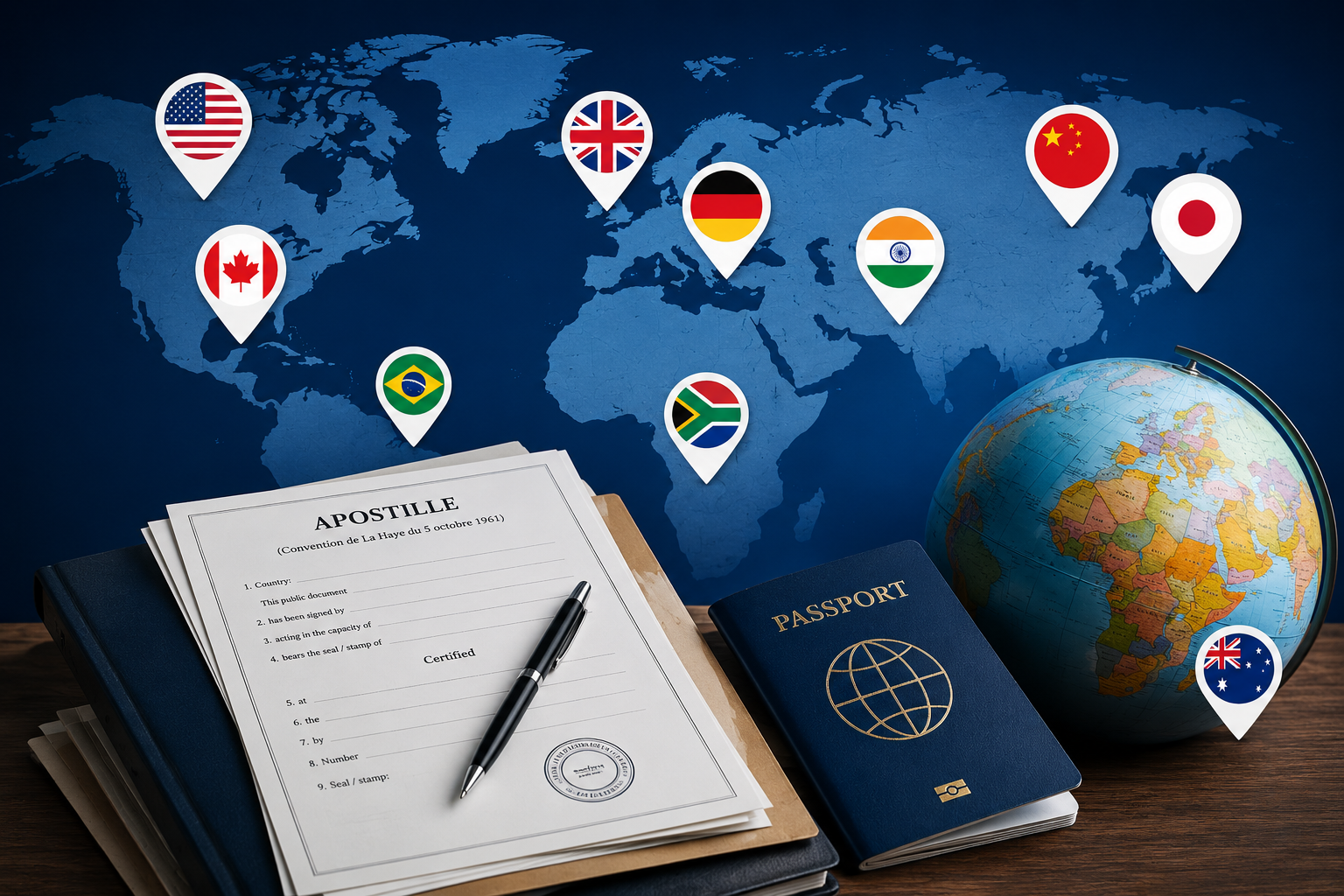
There are 130 apostille countries in 2026. These are the contracting parties to the Hague Apostille Convention, and a U.S. document with an apostille is accepted in each of them without embassy legalization. This page lists all 130 by region, the countries that are not members, and what to do in each case.
This list was checked against the official HCCH status table in October 2026.
- Members: 130, including Thailand, where the Convention takes effect on February 28, 2027
- Newest members: Vietnam (September 11, 2026) and Algeria (July 9, 2026)
- Common non-members: United Arab Emirates, Egypt, Qatar, Kuwait, Jordan, Malaysia, Kenya and Nigeria
Not sure which route your document needs? Call (971) 514-3743 and we will tell you.

What is an apostille?
An apostille is a certificate that confirms the signature, seal or stamp on a public document is genuine, so the document can be used in another country. It was created by the 1961 Hague Convention Abolishing the Requirement of Legalisation for Foreign Public Documents. It does not verify the content of the document.
Complete list of apostille countries in 2026
Europe (49)
Albania, Andorra, Armenia, Austria, Azerbaijan, Belarus, Belgium, Bosnia and Herzegovina, Bulgaria, Croatia, Cyprus, Czechia, Denmark, Estonia, Finland, France, Georgia, Germany, Greece, Hungary, Iceland, Ireland, Italy, Kosovo, Latvia, Liechtenstein, Lithuania, Luxembourg, Malta, Moldova, Monaco, Montenegro, Netherlands, North Macedonia, Norway, Poland, Portugal, Romania, Russia, San Marino, Serbia, Slovakia, Slovenia, Spain, Sweden, Switzerland, Türkiye, Ukraine and the United Kingdom.
The Americas (33)
Antigua and Barbuda, Argentina, Bahamas, Barbados, Belize, Bolivia, Brazil, Canada, Chile, Colombia, Costa Rica, Dominica, Dominican Republic, Ecuador, El Salvador, Grenada, Guatemala, Guyana, Honduras, Jamaica, Mexico, Nicaragua, Panama, Paraguay, Peru, Saint Kitts and Nevis, Saint Lucia, Saint Vincent and the Grenadines, Suriname, Trinidad and Tobago, United States, Uruguay and Venezuela.
Asia and the Pacific (27)
Australia, Bangladesh, Brunei Darussalam, China (including Hong Kong and Macau), Cook Islands, Fiji, India, Indonesia, Japan, Kazakhstan, Kyrgyzstan, Marshall Islands, Mongolia, New Zealand, Niue, Pakistan, Palau, Philippines, Samoa, Singapore, South Korea, Tajikistan, Thailand (from February 28, 2027), Tonga, Uzbekistan, Vanuatu and Vietnam.
Africa (17)
Algeria, Botswana, Burundi, Cabo Verde, Eswatini, Lesotho, Liberia, Malawi, Mauritius, Morocco, Namibia, Rwanda, Sao Tome and Principe, Senegal, Seychelles, South Africa and Tunisia.
Middle East (4)
Bahrain, Israel, Oman and Saudi Arabia.
A few members have objected to another country’s accession, which means the Convention does not apply between those two countries. If your document is going somewhere unusual, check the official HCCH status table or ask us before you start.
Countries that joined recently
- Thailand: takes effect February 28, 2027
- Vietnam: September 11, 2026
- Algeria: July 9, 2026
- Bangladesh: March 30, 2025
- Rwanda: June 5, 2024
- Canada: January 11, 2024
- China: November 7, 2023
- Senegal: March 23, 2023
- Pakistan: March 9, 2023
- Saudi Arabia: December 7, 2022
- Indonesia: June 4, 2022
Non-Hague countries in 2026: where an apostille is not accepted
These frequently requested destinations are not parties to the Convention. This is not a complete list of non-members, so check any country you do not see on the member list above.
- Middle East: United Arab Emirates, Qatar, Kuwait, Jordan, Lebanon, Iraq and Iran
- Africa: Egypt, Kenya, Nigeria, Ghana, Ethiopia, Uganda, Tanzania, Libya and Zimbabwe
- Asia: Malaysia, Cambodia, Myanmar, Nepal, Sri Lanka, Afghanistan, Turkmenistan and Taiwan
- Americas: Cuba and Haiti
For these countries a standard apostille is not enough. The document goes through consular legalization instead: authentication at the state or federal level, then the U.S. Department of State where required, then the destination country’s embassy or consulate. It takes longer and costs more, and each embassy sets its own requirements. We handle embassy legalization as well as apostilles. See our pages on document legalization for Egypt and document legalization for the UAE.
Which documents can be apostilled?
Apostilles are issued for public documents. Common examples are birth, marriage and death certificates, divorce decrees, diplomas and transcripts, notarized affidavits, powers of attorney, corporate documents, court records and background checks. A private document, such as a letter or a contract between individuals, usually has to be notarized first.
How to use this list
- Destination is a member: you need an apostille. In the United States this usually comes from the Secretary of State of the state that issued the document. Federal documents, such as FBI background checks, go through the U.S. Department of State.
- Destination is not a member: you need embassy legalization, which we also handle. Call us to confirm the steps.
- Destination has joined but is not yet in force: this currently applies to Thailand. Use embassy legalization until the effective date.
Frequently asked questions
How many apostille countries are there in 2026?
The Hague Apostille Convention has 130 contracting parties according to the official HCCH status table. That count includes Thailand, where the Convention takes effect on February 28, 2027.
Is China an apostille country?
Yes. The Convention has been in force for China since November 7, 2023, and it also covers Hong Kong and Macau.
Is Canada an apostille country?
Yes. The Convention has been in force for Canada since January 11, 2024.
Is Saudi Arabia an apostille country?
Yes. The Convention has been in force for Saudi Arabia since December 7, 2022.
Is Indonesia an apostille country?
Yes. The Convention has been in force for Indonesia since June 4, 2022.
Is the UAE an apostille country?
No. The United Arab Emirates is not a party to the Convention, so documents for the UAE need embassy legalization instead of an apostille.
Is Thailand an apostille country?
Thailand has joined, but the Convention does not take effect there until February 28, 2027. Until then, documents for Thailand still need embassy legalization.
Need a document apostilled?
Apostille Authentications processes documents from all 50 states for use in any Convention country. Call or message us on WhatsApp at (971) 514-3743 and we will confirm which route your document needs and how long it will take.
Related guides: Complete Guide to Getting Documents Apostilled: International Authentication Made Simple · Understanding Apostilles: Your Complete Guide to Document Authentication for International Use