

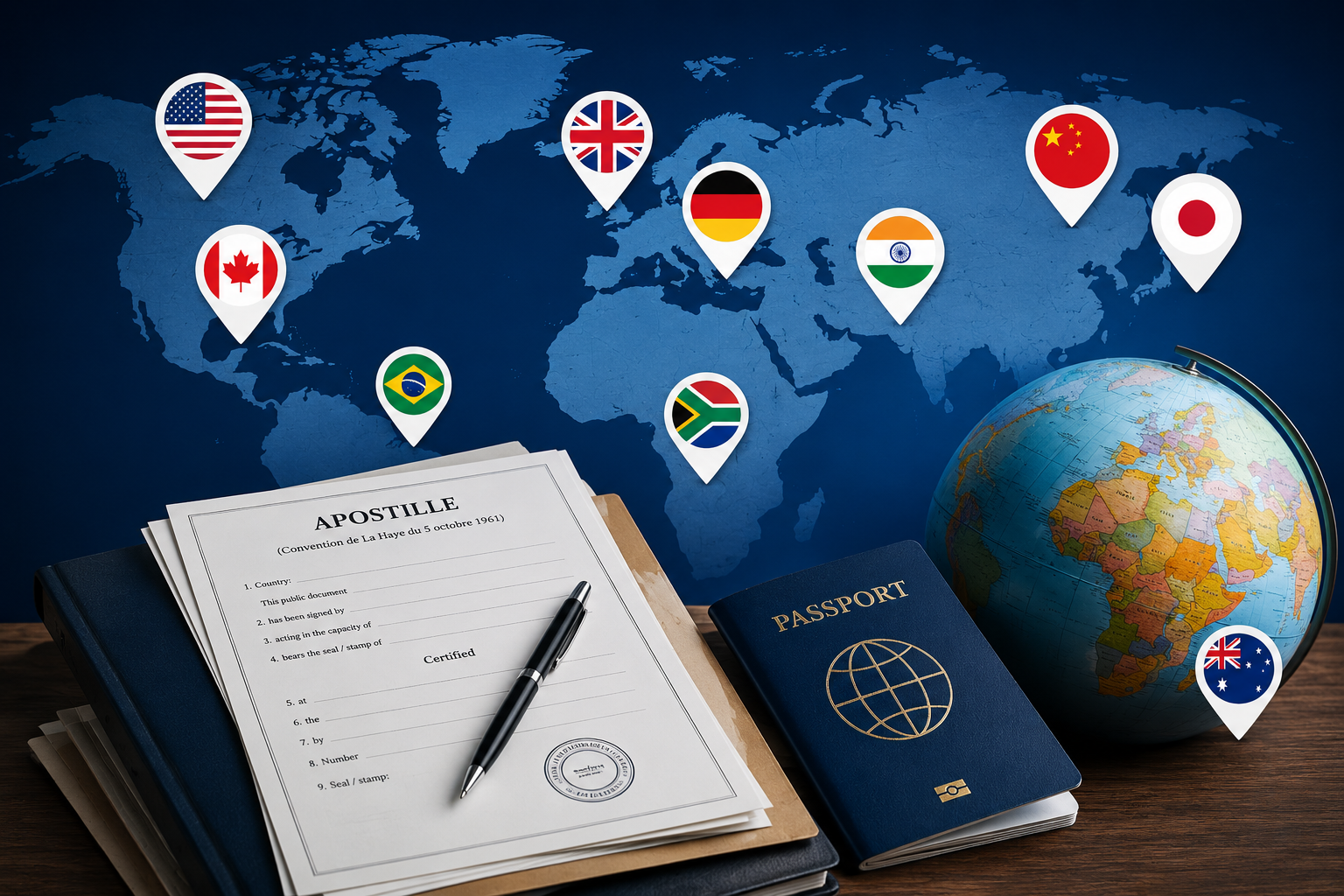
If you are preparing documents for international use, knowing which apostille countries belong to the Hague Convention is one of the most important things you can do.
Without this knowledge, your paperwork could get rejected, delayed, or sent through a much longer legalization process.
This guide gives you a current, reliable breakdown of all apostille countries as of 2026, including recent additions, notable exceptions, and what to do if your destination is not on the list.
What Is an Apostille and Why Does It Matter?
An apostille is an official government certification that authenticates a public document for use in another country.
It was created under the 1961 Hague Convention, formally known as the Convention Abolishing the Requirement of Legalisation for Foreign Public Documents.
When a document carries an apostille, any of the other member apostille countries must recognize it as legally valid without additional embassy certification.
This saves enormous time and cost for individuals, businesses, and legal professionals.
The apostille does not verify the content of a document. It only confirms that the signature, seal, or stamp on the document is genuine.
How Many Apostille Countries Exist in 2026?
As of April 2026, there are 129 contracting parties to the Hague Apostille Convention.
This number has grown significantly over the past few years, making it easier than ever to use authenticated documents across borders.
Notable recent additions include China, which joined effective November 7, 2023, Canada, which joined effective January 11, 2024, Rwanda, which joined effective June 5, 2024, and Bangladesh, which joined effective March 30, 2025.
Viet Nam deposited its instrument of accession on December 31, 2025, and will officially become a full member with effect from September 11, 2026.
These additions reflect a growing global shift toward streamlined document authentication, which benefits millions of people working, studying, and traveling internationally.
The Complete List of Apostille Countries in 2026
Below is a full regional breakdown of all nations currently recognized under the Hague Convention as of 2026.
Europe
Europe is home to the largest concentration of members in the world. Every EU member state belongs to the Convention, along with most non-EU nations.
Albania, Andorra, Austria, Belarus, Belgium, Bosnia and Herzegovina, Bulgaria, Croatia, Cyprus, Czech Republic, Denmark, Estonia, Finland, France, Georgia, Germany, Greece, Hungary, Iceland, Ireland, Italy, Kosovo, Latvia, Liechtenstein, Lithuania, Luxembourg, Malta, Moldova, Monaco, Montenegro, Netherlands, North Macedonia, Norway, Poland, Portugal, Romania, Russia, San Marino, Serbia, Slovakia, Slovenia, Spain, Sweden, Switzerland, Ukraine, and the United Kingdom are all active members.
This wide coverage means that a document apostilled in one European nation is recognized across all others without any additional steps.
The Americas
North America, Central America, South America, and the Caribbean are all well represented among recognized apostille countries.
In North America, the United States, Canada, and Mexico are all members. Canada only joined in January 2024, which surprised many professionals who assumed it had long been part of the network.
In Central America, Belize, Costa Rica, El Salvador, Guatemala, Honduras, Nicaragua, and Panama are all members.
In South America, Argentina, Bolivia, Brazil, Chile, Colombia, Ecuador, Guyana, Paraguay, Peru, Suriname, Uruguay, and Venezuela all belong to the Convention.
The Caribbean nations of Antigua and Barbuda, Barbados, Dominica, Dominican Republic, Grenada, Saint Kitts and Nevis, Saint Lucia, Saint Vincent and the Grenadines, Trinidad and Tobago, and the Bahamas round out this region.
Asia and the Pacific
Asia has seen remarkable growth in membership over recent years.
In East and Southeast Asia, China (including Hong Kong and Macau through territorial extension), Japan, South Korea, Mongolia, Brunei Darussalam, and the Philippines are all active members.
In South Asia, India, Pakistan, and Bangladesh are all part of the network. Bangladesh joined in March 2025, making it one of the newest members.
In Central Asia, Armenia, Azerbaijan, Kazakhstan, Kyrgyzstan, Tajikistan, Turkmenistan, and Uzbekistan are all recognized members.
In the Pacific, Australia, Cook Islands, Fiji, Marshall Islands, New Zealand, Niue, Palau, Samoa, Tonga, and Vanuatu are all parties to the Convention.
Africa
Africa has a smaller but steadily growing presence on the list.
Botswana, Burundi, Cape Verde, Eswatini, Lesotho, Liberia, Malawi, Mauritius, Namibia, Rwanda, Sao Tome and Principe, Seychelles, South Africa, and Zimbabwe are all current members.
Rwanda joined in June 2024, reflecting continued expansion across the African continent.
The Middle East and North Africa
Participation is more limited in this region, but several key nations are members.
Bahrain, Israel, Jordan, Morocco, and Oman are all part of the Convention.
It is important to note that several of the region’s most frequently visited destinations, including the UAE and Saudi Arabia, are not part of the recognized apostille countries network. Documents intended for those destinations still require embassy attestation.

Which Nations Are NOT on the List?
Knowing which nations fall outside the framework is just as important as knowing which ones are inside it.
Major non-members as of 2026 include the UAE, Saudi Arabia, Indonesia, Egypt, and several others across Africa and Southeast Asia.
For these destinations, a standard apostille is not sufficient. Documents must go through consular legalization or embassy attestation instead.
This process typically involves authentication at the state or federal level, followed by verification through the U.S. Department of State, and then submission to the destination country’s embassy or consulate.
The process is longer, more expensive, and requires careful attention to requirements that vary by country.
What Documents Can Be Apostilled?
Once you confirm that your destination is among the recognized apostille countries, the next question is which documents qualify.
Apostilles can be placed on public documents, which cover a wide range of official papers.
Common documents sent abroad include birth certificates, marriage certificates, divorce decrees, death certificates, educational diplomas and transcripts, notarized affidavits, corporate documents, powers of attorney, court records, and background checks.
Documents that are purely private, such as personal letters or contracts between individuals, generally cannot receive an apostille unless they have first been notarized by a public official.
Once notarized, the notary’s signature itself becomes a public document eligible for authentication.
How to Use This Apostille Countries List for Your Documents
Start by identifying the country where your document was issued and the country where it will be used.
If both countries are among the recognized apostille countries, you are eligible for the simplified apostille route.
Contact the competent authority in the issuing country to begin the apostille process. In the United States, that is typically your state’s Secretary of State office.
If the destination is not among the apostille countries, contact the relevant embassy or a professional document service to determine what legalization steps are required.
When in doubt, working with a professional apostille service ensures your documents are processed correctly, quickly, and without costly errors.
Why Working With a Professional Apostille Service Matters
Navigating the requirements of 129 apostille countries on your own can be overwhelming.
Requirements change. New apostille countries join the Convention. Processing times shift. Document standards vary by state and country.
A trusted apostille service stays current on all these changes and handles every step on your behalf.
Whether you need documents apostilled for business registration in Europe, academic enrollment in Latin America, residency applications in Asia, or legal proceedings across any of the apostille countries, professional guidance makes the entire process faster and more reliable.
At Apostille Authentications, we specialize in processing documents for all apostille countries quickly and accurately.
Our team handles every type of document, every state, and every destination country in the Convention.
Final Thoughts on Apostille Countries in 2026
The network of apostille countries continues to grow every year, making international document authentication more accessible than ever before.
With 129 members as of 2026, the chances are high that your destination country is among the recognized apostille countries.
But confirmation is always worth it before you begin.
Verify your destination against the official HCCH status table, prepare the correct documents, and work with a professional service to make sure everything is handled properly.
If you need help apostilling documents for any of the apostille countries, contact Apostille Authentications today for fast, expert service you can trust.