
If you have ever needed to use a document in a foreign country, you have probably heard terms like apostille, authentication, and notarization thrown around.
These three processes sound similar. They are not.
Mixing them up can delay your visa, stall your business deal, or even get your documents rejected at a foreign embassy.
This guide breaks down exactly what each process means, when you need it, and how a trusted apostille authentication service can make the entire experience far less stressful.
What Is Notarization?
Notarization is the most basic level of document verification available in the United States.
A notary public is a state-appointed official who verifies the identity of the person signing a document. The notary then stamps and signs the document to confirm that the signature is genuine.
This is where the process starts, but it does not go very far on its own.
Notarization confirms who signed a document. It does not verify the content of the document, and it carries no legal weight outside the country.
Common documents that require notarization include affidavits, powers of attorney, real estate deeds, and financial agreements.
If you are using a document only within the United States, notarization may be all you need.
But the moment that document needs to cross a border, notarization alone is rarely enough.
What Is Authentication?
Authentication is a multi-step process that goes beyond notarization.
After a document is notarized, it must be certified at several levels of government before it can be accepted in certain countries.
The typical authentication chain in the United States looks like this:
First, the document is notarized by a state-commissioned notary public. Then, the notary’s signature is certified by the county clerk or the state’s Secretary of State. After that, the U.S. Department of State authenticates the document at the federal level. Finally, the embassy or consulate of the destination country places its own seal on the document.
This final step, known as legalization or consular authentication, is what makes the document legally usable in that specific foreign country.
Authentication is required for countries that are not members of the Hague Apostille Convention of 1961.
If you are sending documents to countries in parts of Asia, the Middle East, or Africa, you will likely need full authentication rather than an apostille.
This is a longer, more complex process, which is exactly why many individuals and businesses turn to a professional apostille authentication service to handle it on their behalf.
What Is an Apostille?
An apostille is a specialized certificate issued by a government authority that verifies the authenticity of a public document for use in another country.
The apostille was introduced under the Hague Convention of October 5, 1961, and it applies only between the countries that are members of this convention.
Currently, more than 120 countries are members of the Hague Apostille Convention.
When a country is a member, the apostille acts as a streamlined form of authentication. It eliminates the need for the lengthy multi-step embassy legalization process.
Instead, one single apostille certificate is attached to your document, and it is recognized directly by the destination country.
The apostille itself includes the name of the country issuing it, the name of the person who signed the document, the title of the person who stamped or sealed the document, the name of the city where the document was issued, the date of issue, and a unique identifying number.
In the United States, apostilles are issued by the Secretary of State in each state, or by the U.S. Department of State for federal documents.
An apostille authentication service handles all the submission, tracking, and delivery so you receive a certified document without unnecessary delays.
The Core Differences at a Glance
Understanding the differences between these three processes is critical before submitting any international documents.
Notarization is a domestic verification of a signature. It is performed by a notary public. It carries legal weight only within the United States and has no international recognition on its own.
Authentication is a chain of certifications required for documents going to countries outside the Hague Apostille Convention. It involves multiple government agencies and embassies. It is the most time-consuming option.
Apostille is a single-certificate verification required for documents going to countries that are members of the Hague Apostille Convention. It is faster than full authentication and is widely accepted across more than 120 countries.
A reliable apostille authentication service will first determine which process your specific document requires before proceeding with any filings.
When Do You Need an Apostille?
You need an apostille when you are sending documents to a country that is part of the Hague Convention and that country requires official verification of your document.
Common situations where people seek an apostille authentication service include:
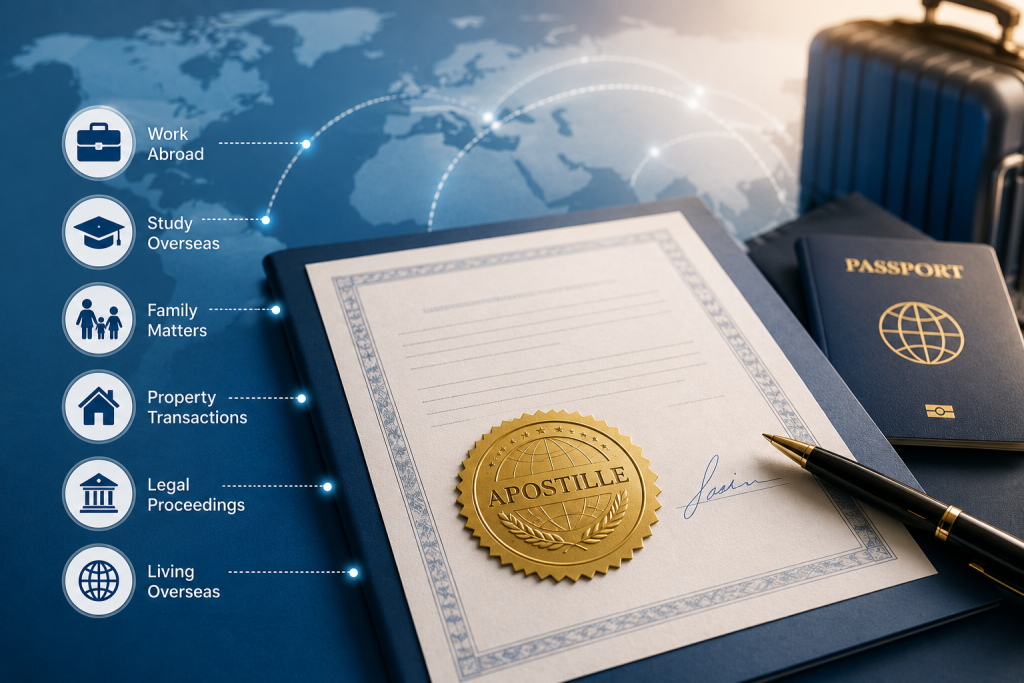
Studying abroad. Universities in countries like Spain, Italy, Germany, and Brazil require apostilled academic transcripts, diplomas, and background checks before accepting international students.
Getting married overseas. Many countries require apostilled birth certificates, proof of single status, and other civil documents before they will permit a foreign national to marry on their soil.
Starting a business internationally. Companies expanding into Hague Convention member countries need apostilled articles of incorporation, powers of attorney, and financial documents.
Adopting a child from another country. International adoptions require extensive apostilled documentation to satisfy both the home country and the destination country.
Working abroad. Employment visas often require apostilled background checks, degrees, and professional certifications.
Retiring overseas. Retirees applying for long-term residency visas in places like Portugal, Mexico, or Panama are frequently asked to provide apostilled pension letters, bank statements, and birth certificates.
In every one of these situations, an apostille authentication service reduces the burden by navigating the paperwork requirements on your behalf.
When Do You Need Full Authentication Instead?
If the country where you plan to use your document is not a member of the Hague Apostille Convention, you will need to go through the full authentication process instead.
Countries like China, Kuwait, the United Arab Emirates, Vietnam, and several others have not joined the Hague Convention.
For these destinations, your documents must pass through the complete chain: notary, state certification, federal certification, and then consular legalization at the embassy or consulate of the destination country.
This process can take weeks, sometimes longer, depending on the embassy’s workload and the type of document involved.
A professional apostille authentication service that also handles consular legalization can coordinate all of these steps simultaneously and keep the timeline as short as possible.
Knowing whether your destination country is in the Hague Convention is the very first step, and it determines everything else that follows.
What Types of Documents Can Be Apostilled?
Not every document qualifies for an apostille. Only public documents are eligible.
Public documents include birth certificates, death certificates, marriage certificates, divorce decrees, court judgments, educational diplomas and transcripts, notarized private documents, government-issued background checks, and corporate documents issued or notarized by government officials.
Private documents, like personal letters, resumes, or privately drafted contracts, must first be notarized by a notary public before they can be submitted for an apostille.
A knowledgeable apostille authentication service will advise you on whether your document qualifies as a public document, whether it needs notarization first, and which government office has authority to issue the apostille for your specific document type.
How Long Does the Process Take?
Processing times vary widely depending on the type of document, the issuing state, and whether you are requesting an apostille or full authentication.
State-level apostilles typically take anywhere from a few days to several weeks, depending on the Secretary of State’s current workload. Some states offer expedited processing for an additional fee.
Federal apostilles for documents issued by U.S. federal agencies are processed by the U.S. Department of State’s Office of Authentications, and standard processing can take two to three weeks.
Full authentication for non-Hague countries takes longer still, often four to eight weeks, depending on the embassy involved.
When you use an apostille authentication service, expedited options are usually available. The service has established relationships with government offices and knows how to prioritize your submission to reduce turnaround time.
Common Mistakes to Avoid
There are several costly mistakes that people make when attempting to handle apostille or authentication on their own.
Submitting the wrong document type. Some countries require an original certified copy, not a photocopy. Others accept notarized copies. Submitting the wrong format will result in rejection and delays.
Missing the signature chain. Authentication requires every signature along the chain to be certified in the correct order. Skipping a step, even accidentally, invalidates the entire document.
Failing to check the destination country’s requirements. Requirements differ not just by country but sometimes by the specific purpose of the document. A marriage certificate submitted for a visa application may have different requirements than the same certificate submitted for a residency permit.
Using an expired document. Many countries specify that documents must have been issued within a certain timeframe. An apostille authentication service will flag outdated documents before submission.
Trusting unofficial intermediaries. Not all document service providers are accredited or reputable. Always work with a verified apostille authentication service that has transparent pricing, clear timelines, and verifiable customer reviews.
Why Use a Professional Apostille Authentication Service?
Handling apostille or authentication requests independently is possible, but it is rarely the most efficient path.
Government offices have specific requirements for how documents must be submitted, what fees are required, and how returns are processed. One small error at any point in the chain can result in rejection and force you to start over.
A professional apostille authentication service understands every detail of this process.
They know which documents require state-level processing versus federal processing. They know which states allow online submissions and which require in-person filing. They track your documents from submission to return. They alert you if any issues arise.
For individuals, using an apostille authentication service means less time spent researching confusing government procedures and more time focusing on the actual reason you need the document in the first place.
For businesses, an apostille authentication service becomes a reliable partner for handling the volume of international documentation that grows with your expansion.
Choosing the Right Apostille Authentication Service
Not all services are created equal. When choosing a provider, look for the following qualities.
Experience and specialization. A service that focuses exclusively on document authentication and apostille processing will have deeper expertise than a general legal document service.
Clear communication. You should receive regular updates on the status of your documents. An apostille authentication service that leaves you in the dark is not worth your time or money.
Knowledge of international requirements. Requirements change. Embassies update their procedures. Countries join or leave conventions. Your service provider should stay current on all of these changes so you do not have to.
Transparent pricing. There should be no hidden fees. Government filing fees, courier costs, and service charges should all be clearly disclosed upfront.
Positive track record. Look for verified reviews and testimonials from real customers who have used the apostille authentication service for situations similar to yours.
At ApostilleAuthentications.com, our apostille authentication service is built around transparency, speed, and accuracy. We handle every step of the process so your documents arrive correctly certified and on time.
Final Thoughts
Notarization, authentication, and apostille are three distinct processes designed for three distinct purposes.
Notarization verifies a signature for domestic use. Authentication certifies a document for use in non-Hague countries through a chain of government and embassy approvals. An apostille provides streamlined international certification for use in Hague Convention member countries.
Getting the right process the first time saves you time, money, and a great deal of frustration.
Whether you are a student, a professional, a business owner, or someone planning a major life event abroad, working with a trusted apostille authentication service is the smartest decision you can make when your documents need to cross borders.
Ready to get started? Visit ApostilleAuthentications.com and let our apostille authentication service take the complexity out of international document certification.