
Understanding apostille requirements 2026 is the first step for anyone who needs a document accepted abroad, because three real changes just moved the goalposts. Vietnam started accepting apostilles on September 11, 2026. Algeria made the same switch in July. Thailand is set to join in February 2027. On top of that, the U.S. Department of State is now processing mailed federal requests within about five weeks of receipt, while walk in submissions at the Washington office come back in seven business days. If you are trying to figure out where your paperwork goes and how long it will take, the apostille requirements 2026 landscape looks different from what most articles online still describe.
We hear the same frustrated call several times a week. Someone has a consulate appointment in three weeks. They mailed an FBI background check to a Secretary of State office because a forum post told them to, and it came back untouched, with a note explaining that office has no authority over federal documents. They are now out six weeks with the appointment still on the calendar. Almost every rejection we see traces back to one of three problems under the current apostille requirements 2026 rules: the document went to the wrong office, the destination country changed its rules, or someone ordered the wrong version of a certificate. This guide walks through all three so you are not the next person caught off guard.
What actually changed under apostille requirements 2026
Vietnam is the biggest shift in the apostille requirements 2026 update, and it is the one still published incorrectly across the internet. Vietnam deposited its accession to the Hague Apostille Convention on December 31, 2025, and the treaty formally entered into force there on September 11, 2026. Before that date, a document headed to Vietnam needed an authentication certificate from the State Department followed by legalization at the Vietnamese embassy or consulate. Under the current apostille requirements 2026 framework, most eligible public documents now need only a single apostille. No embassy stop, no second fee, and no extra two to three weeks tacked onto the timeline.
Two details still matter here. Germany and Austria filed formal objections to Vietnam joining, so the simplified apostille route does not apply between those two countries and Vietnam specifically. Vietnam also issued implementing rules, Decree 293 of 2026, that include transitional provisions for consular certification requests already filed before the switchover date. Anyone with a Vietnam file that has been sitting in progress since summer should confirm which track applies before sending anything else, because picking the wrong one under the new apostille requirements 2026 rules is the fastest way to lose a month.
Algeria and Thailand join the list
Algeria has been part of the Convention since July 9, 2026, so documents that once needed Algerian embassy legalization now take a plain apostille as well. Thailand deposited its accession on June 30, 2026, with entry into force scheduled for February 28, 2027, so Thai bound paperwork still follows the legalization route for now. That timeline is part of why apostille requirements 2026 planning has to account for a country list that keeps shifting. The Convention now covers roughly 130 member countries, and recent additions include Bangladesh, Canada, China and Saudi Arabia. Any published list goes stale within months, which is exactly why the destination country status gets checked individually on every order rather than pulled from memory.
Italy, and a wider tightening trend
Under apostille requirements 2026, Italy raised the bar for citizenship claims through ancestry in 2025, and a series of rulings and budget provisions layered more procedure on top of that. For applicants who still qualify, the paperwork standard is strict under the current apostille requirements 2026 environment. Every foreign issued record in the family line needs an apostille plus a sworn Italian translation, and a single missing apostille can send back a file that took years to schedule an appointment for. The same tightening shows up in Spain, Portugal, Colombia, South Korea and across the Gulf states under apostille requirements 2026. More records get requested, certification gets stricter, and reviewers have far less patience for a certificate that is technically the wrong version.
Background checks face closer scrutiny on both sides
For U.S. immigrant visa cases, police certificates are not a consular preference, they are written directly into federal regulation, and consular officers cannot waive them. They are generally treated as valid for two years from the date of issue. Foreign governments apply comparable rules to the U.S. side of a file, which is part of why the FBI Identity History Summary remains the single most common document that crosses our desk under current apostille requirements 2026 practice.
Federal apostille or state apostille, get this right first
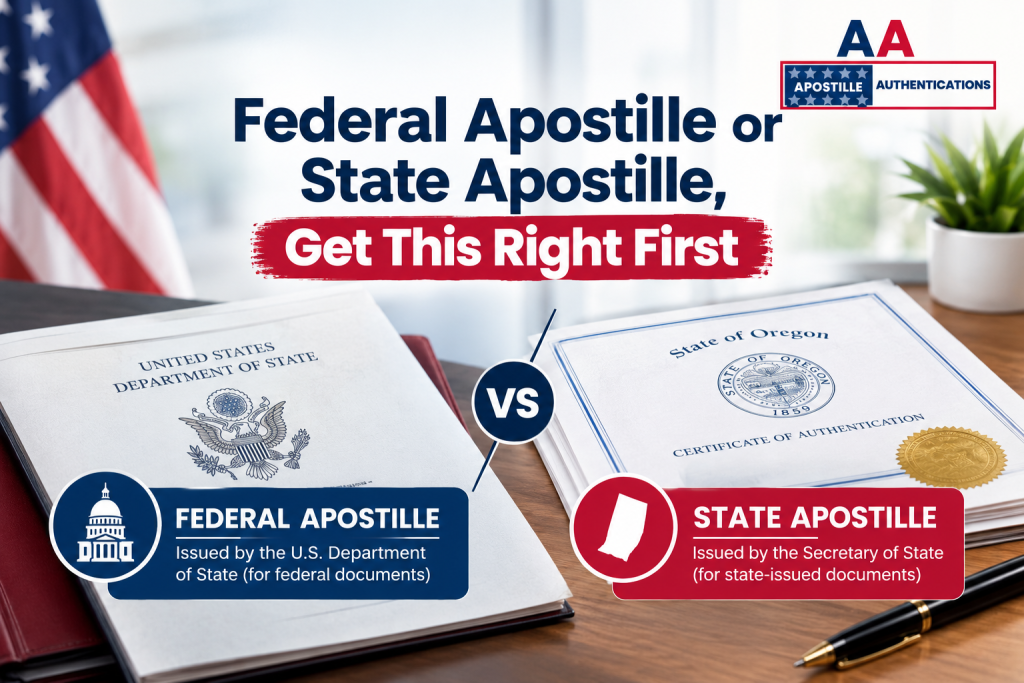
Every question about apostille requirements 2026 eventually comes back to one rule, and it is simple. Whoever issued the document decides who apostilles it. Nothing else about your file matters until this part is settled.
Under apostille requirements 2026, documents issued by a federal agency or a federal court go to the U.S. Department of State Office of Authentications in Washington. That covers an FBI background check, known formally as the Identity History Summary, along with USCIS naturalization and immigration records, federal court records, patents and trademarks from the USPTO, certificates from the FDA, USDA or DEA, Social Security letters and IRS Form 6166.
Under apostille requirements 2026, documents issued by a state office, a county, or a notary go to that state’s Secretary of State. That covers birth, marriage, divorce and death certificates, state police background checks, diplomas and transcripts, and notarized affidavits, powers of attorney and corporate records.
An FBI background check can never be apostilled by a Secretary of State, not in Oregon, not in Washington, not anywhere. Send it to the wrong office under apostille requirements 2026 and it comes back unprocessed, minus whatever weeks it spent traveling by mail in both directions. You also cannot shortcut the federal route by having a notary certify a photocopy of a federal document. That is a documented rejection reason at the State Department, not a clever workaround, and it is one of the fastest ways to lose weeks under current apostille requirements 2026 processing.
How long each route actually takes right now
Timelines are the part of apostille requirements 2026 that changes most often, so here is where things stand this quarter. Mailed requests to the U.S. Department of State are processed within about five weeks of receipt, and that window does not include mail transit in either direction. A delivered tracking scan does not mean your request has reached the review queue yet. Walk in drop off submissions come back in seven business days. Drop off runs 7:30 to 9:00 a.m., Monday through Thursday, one request per customer per day, fifteen document limit, and no walk ins on Fridays. Emergency same day appointments exist only for a narrow exception involving a life or death situation abroad, with documentation required.
State level timing varies widely under apostille requirements 2026. Oregon offers same day counter service and three to five business days by mail, ten dollars per document, through the Corporation Division in Salem, accepting originals or certified copies only. Other states run one to ten business days depending on staffing and volume. Embassy legalization for non Hague countries adds another one to four weeks, dependent on that embassy’s queue, fees and translation rules.
Every federal request has to include Form DS 4194, and the destination country field on that form has to be correct. Under apostille requirements 2026, that single line determines whether the document gets a proper apostille or an authentication certificate instead, and naming the wrong country results in a rejection rather than a simple correction.
Getting an apostille in Oregon and the Portland metro area
Oregon apostilles come from the Secretary of State’s Corporation Division in Salem, at 255 Capitol Street Northeast, Suite 151. The fee is ten dollars per document. Counter service is same day, and mail service usually runs three to five business days plus shipping time. A few things trip up Oregon residents navigating apostille requirements 2026 for the first time. Photocopies are rejected on arrival, since Salem requires originals or certified copies, not a scan, a printout, or a keepsake hospital certificate. Diplomas and transcripts need an extra step, since the registrar must sign a certifying statement that then gets notarized. Vital records follow their own path too, since Oregon birth, marriage and death certificates must come from the Center for Health Statistics or the relevant county office first. Valuable documents should never travel by regular mail, since the state recommends FedEx or UPS for time sensitive items.
Local service is available with mobile notaries who travel across Portland, Beaverton, Hillsboro, Lake Oswego, Tigard, Gresham and Vancouver, Washington, including evenings and weekends. For anyone outside that metro area or outside Oregon entirely, mail based service covers all fifty states, which is how most clients actually work through their apostille requirements 2026 paperwork.
The documents we handle most often
For visas, residency and relocation, the common documents are the FBI Identity History Summary background check, state police and criminal background checks, birth, marriage, divorce and death certificates, single status affidavits and no impediment letters, and medical letters and vaccination records.
For work and study abroad, the list typically includes diplomas, transcripts and enrollment verification letters, TEFL and TESOL certificates and professional licenses, and employment contracts and letters of experience.
For citizenship by descent and family matters under apostille requirements 2026, expect long form birth and marriage certificates for every generation in the line, naturalization records or certificates of non naturalization, adoption decrees and court orders, and powers of attorney.
For business and corporate needs, common documents include articles of incorporation, bylaws and certificates of good standing, board resolutions and commercial invoices, patents, trademarks and USPTO assignments, and FDA certificates of free sale along with export paperwork.
When you still need embassy legalization
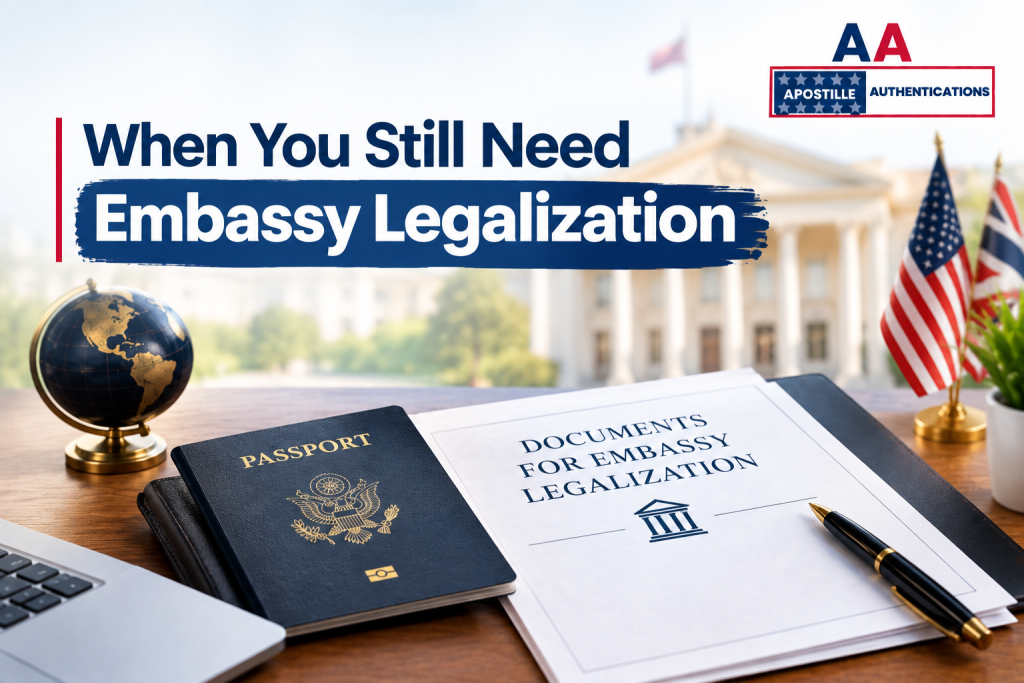
If the destination country is not a member of the Hague Convention, an apostille will not be accepted there, full stop. Those documents still need an authentication certificate from the U.S. Department of State first, followed by legalization at that country’s embassy or consulate. Countries that still require the full chain include the United Arab Emirates, Qatar, Kuwait, Egypt, Jordan, Lebanon, Iraq, Libya and Taiwan. Each of these destinations has its own embassy fees, appointment windows and translation preferences, so the legalization timeline can swing by several weeks depending on which consulate is handling the file and how busy that office happens to be that month.
Vietnam left that list this month under the new apostille requirements 2026 framework. Algeria left it in July. Thailand leaves it next February. This is exactly why advice from a coworker who handled this last year is often unreliable, and why the destination country’s current status gets verified before anything gets submitted.
Five mistakes that cost people the most time
The first common mistake is ordering the wrong version of a certificate. You need the long form certified copy with the registrar’s signature and seal, since short form, abstract and souvenir versions all get rejected.
The second mistake is ordering too early. Plenty of consulates only accept background checks and civil records issued within the last three to six months, so a document that is ready too soon becomes just as useless as one that arrives too late.
The third mistake is translating in the wrong order. Some countries want the translation apostilled alongside the original document. Others want a sworn translator working in country to handle the translation after authentication is complete. Guessing wrong under apostille requirements 2026 usually means paying for the work twice.
The fourth mistake, common under apostille requirements 2026, is a name mismatch. A middle initial that shows up on one record and is missing from another is one of the most common reasons a file gets sent back.
The fifth mistake under apostille requirements 2026 is leaving no buffer at all. Between transit time, federal processing and an embassy queue, a non Hague file can realistically run six to ten weeks, and consulate appointments almost never move to accommodate a late document.
What we do
We handle the entire chain so clients are not coordinating four different agencies while keeping up with apostille requirements 2026 alone. Services include federal apostilles hand delivered to the State Department with secure return shipping, FBI background check apostilles from start to finish, state apostilles across all fifty states and Washington D.C., embassy legalization for every non Hague country, vital record retrieval, certified translations prepared to each destination country’s standard, mobile notary service across the Portland metro included free with an apostille order, and corporate and bulk document authentication. Pricing starts at seventy five dollars and runs to one hundred ninety five dollars depending on route and speed, with review and submission included and no surprise charges.
Not sure which route applies to your paperwork
Send a photo of the document and note which country it is heading to. We will confirm whether the file needs a federal apostille, a state apostille, or full embassy legalization before a dollar gets spent or a week gets lost. The assessment is free, and video consultations are available for anyone with a complicated file that involves multiple documents or countries.
You can reach the team by email at Info@apostilleauthentications.com, through the website, or over WhatsApp chat for a quick question about apostille requirements 2026 as they apply to your specific situation.
Frequently asked questions about apostille requirements 2026
Does an FBI background check need a federal or state apostille?
Federal, always, since the FBI Identity History Summary is a federal document and only the U.S. Department of State can apostille it. A Secretary of State office will return it unprocessed every time.
How long does a federal apostille take in 2026?
Mailed requests are processed within about five weeks of arriving at the Office of Authentications, not counting shipping time in either direction. Walk in drop off submissions come back in seven business days, which is why courier submission usually beats mailing it yourself by weeks.
Do I still need embassy legalization for Vietnam under apostille requirements 2026?
Not for most documents anymore. Vietnam entered the Apostille Convention on September 11, 2026, so eligible public documents now need only a single apostille, though files started before that date may fall under transitional rules and should be checked first.
What if my destination country is not part of the Hague Convention under apostille requirements 2026?
That document will need an authentication certificate from the U.S. Department of State followed by legalization at that country’s embassy or consulate, and both steps can be handled together.
Can I apostille a photocopy?
Usually not, since you need the original document or a certified copy from the agency of record. Having a notary certify a photocopy of a federal document is a common and expensive mistake under apostille requirements 2026 rules.
How long is an apostille valid under apostille requirements 2026?
The apostille itself does not expire, though the document underneath it often does, since many consulates only accept background checks and civil records issued within the last three to six months.
How much does an apostille cost in Oregon under apostille requirements 2026?
The Oregon Secretary of State charges ten dollars per document, and full service pricing starts at seventy five dollars, covering document review, notarization where needed, submission and return shipping.
Can you help if someone is already living overseas?
Yes, and most clients actually are. Records get retrieved, the authentication chain gets run, and everything ships internationally once it is complete.
Quick reference for apostille requirements 2026
Keeping the whole picture straight is easier with a short recap, so here is the apostille requirements 2026 situation in a few lines. Vietnam, Algeria and eventually Thailand have moved or are moving away from embassy legalization toward a single apostille. Federal documents, including the FBI background check, only go to the U.S. Department of State, never to a state office. State issued documents, including birth and marriage certificates, only go to that state’s Secretary of State. Mailed federal requests currently take about five weeks, while walk in drop off in Washington takes seven business days. Oregon residents get same day counter service or three to five business days by mail, and everyone outside Oregon can still work through the process by mail regardless of location.
Anyone planning international paperwork should treat apostille requirements 2026 as a moving target rather than a fixed checklist, because country status and processing windows both shift throughout the year. Checking the current rule for your specific destination before you submit anything is the single habit that prevents the most expensive delays. Under apostille requirements 2026, a document that was fine last year can suddenly need an extra step, and a document that used to need embassy legalization can now clear with a simple apostille instead. That is exactly why guidance from a coworker, a forum post or an old blog post is risky. Confirming the current apostille requirements 2026 rule for your exact document and destination country, every single time, remains the most reliable way to avoid losing weeks to a preventable rejection.
Requirements around apostille requirements 2026 change often and vary by consulate and by document type, so this article is general information rather than legal or immigration advice. Verify current rules with the receiving authority directly, or reach out for a free assessment of your documents before you submit anything.